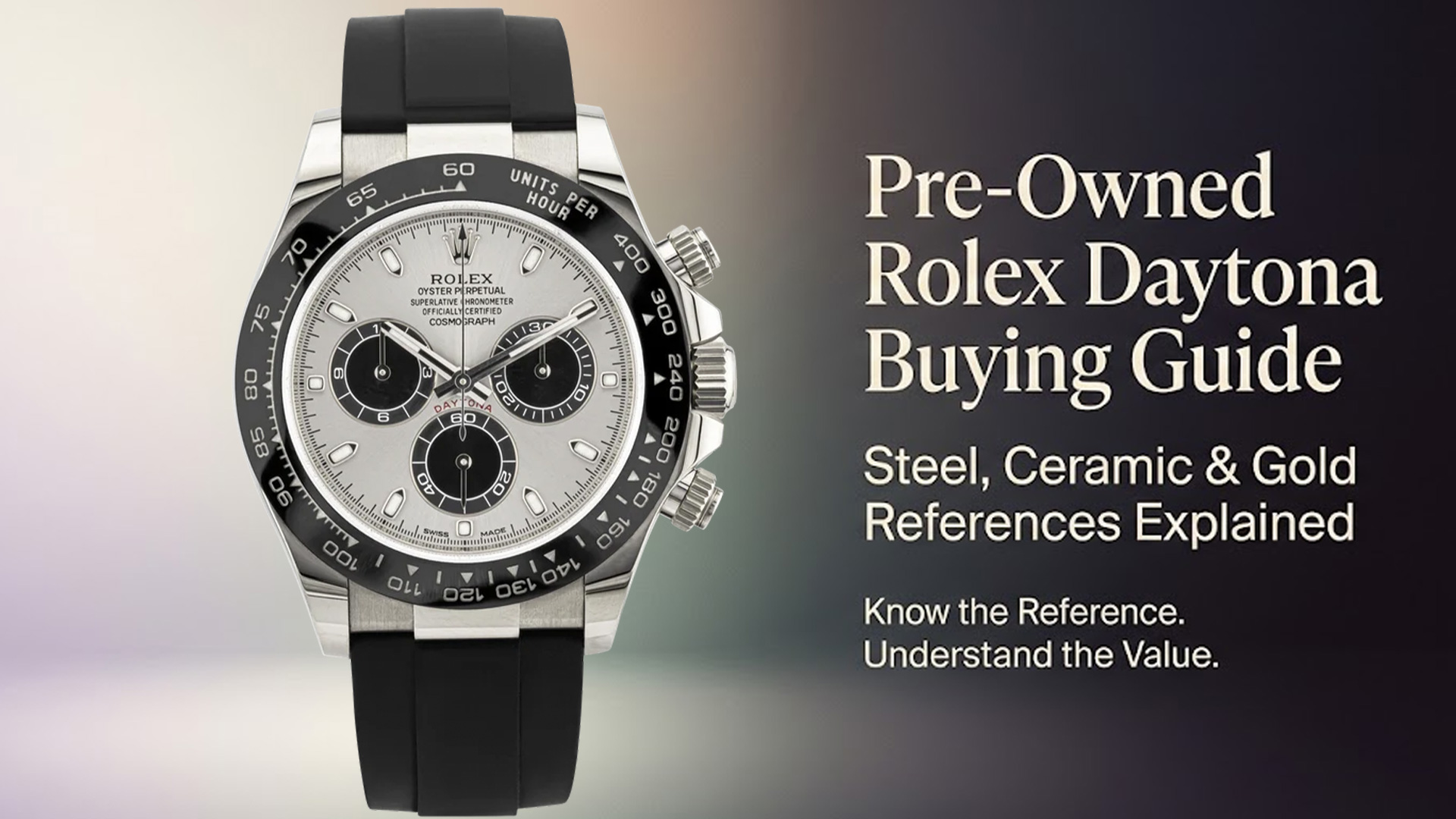
The Daytona is famous enough that its name often gets more attention than its details. For a pre-owned buyer, the details are where the decision gets made.
There is a strange gap between the Rolex Cosmograph Daytona’s reputation and what most buyers know about it. Plenty of people can recognize one across a restaurant. Far fewer can tell you the difference between a 116500LN and a 126500LN, why a steel bezel and a ceramic bezel change the character of the watch, or which generation uses which movement.
For a watch that commands serious money on the secondary market, that gap is risky. A buyer who knows only the name tends to pay for the name. A buyer who understands the references can pay for the watch.
This guide explains the modern Daytona lineup for U.S. buyers: the generations, the materials, the dial choices, and the checks that matter before you commit. If you’d like to compare real examples as you read, browse the current pre-owned Rolex listings.
What the Daytona Actually Is
The Cosmograph Daytona is a chronograph, a watch with a built-in stopwatch. Rolex introduced the Cosmograph in 1963, and its association with motorsport is part of its identity. The tachymeter scale on the bezel lets you calculate average speed over a known distance, a function few owners use and almost everyone appreciates.
The modern Daytona layout is consistent across references: three sub-dials for running seconds, a 30-minute counter and a 12-hour counter, screw-down chronograph pushers, a tachymetric bezel, and water resistance of 100 meters. What changes between generations is the movement, the bezel material, and a set of design refinements that buyers often notice only side by side.
The Modern Daytona Generations
| Approximate era | Steel reference | Movement | Defining traits |
| Late 1980s to 2000 | 16520 | Calibre 4030 (based on an outside chronograph movement) | The first automatic Daytona generation. Now a collector’s watch with its own originality questions. |
| 2000 to 2016 | 116520 | Calibre 4130 (Rolex in-house) | Steel bezel with engraved tachymeter. The start of the in-house automatic era. |
| 2016 to 2023 | 116500LN | Calibre 4130 | Black Cerachrom ceramic bezel. The steel Daytona that defined demand in the late 2010s. |
| 2023 to present | 126500LN | Calibre 4131 | Ceramic bezel framed by a thin metal rim, refined dial and sub-dial details, updated movement. |
The current calibre 4131 offers a power reserve of approximately 72 hours, the same figure generally associated with the 4130. Rolex’s updates in the 4131 focus on refinements such as the Chronergy escapement and finishing. Confirm movement specifications for any particular watch against Rolex’s official documentation rather than relying on a listing.
Steel Bezel vs Ceramic Bezel
This is the visual decision that splits Daytona buyers more than any other.
The steel bezel (116520 and earlier) gives the watch a brighter, more monochrome look. It reads as classic and slightly understated, and some buyers prefer how it ties back to earlier Daytonas. Steel can scratch and, over years, the engraved scale can soften with wear or polishing.
The black Cerachrom ceramic bezel (116500LN and 126500LN) gives sharper contrast and a more contemporary, sporty appearance. Ceramic resists scratching very well and keeps its color, but it can chip or crack from a hard impact. When you inspect a ceramic-bezel Daytona, look closely at the bezel edges.
On the 126500LN, Rolex added a thin metal rim around the ceramic insert. It’s a subtle detail, but it changes the watch’s look in person and is one of the quickest ways to tell the current generation from the 116500LN.
116500LN vs 126500LN: Is the Newer One Better?
This is probably the most common question from steel Daytona buyers right now, and the honest answer depends on what you value.
The 126500LN is the current version, with the newer calibre 4131, refined dial details and the bezel rim. If you want the latest generation and any remaining manufacturer guarantee that comes with a recently purchased watch, it is the natural choice. Confirm coverage from the dated warranty card.
The 116500LN had a seven-year production run and became one of the defining sports watches of its time. Some buyers prefer its cleaner ceramic bezel without the metal rim, and now that it’s discontinued, it has its own following.
Neither is objectively better. The differences are real but subtle, and the condition, completeness and price of the individual watch will usually matter more than the generation itself.
Dial Choices: White, Black and Everything Else
Steel Daytonas are most commonly found with a white dial and black sub-dial rings, or a black dial with contrasting sub-dial rings. The white-dial version is widely nicknamed “Panda” by enthusiasts. That is an informal collector term, not a Rolex name.
Precious-metal Daytonas open up a much wider palette, including gold, green, meteorite, champagne, gem-set and other dials depending on the reference. Some dials become strongly associated with particular references and attract specific demand.
Choose the dial you actually want to wear. If you find yourself choosing a dial because of a nickname or a trend rather than because you like it, take a day before deciding.
Gold, Everose and Platinum Daytonas
Beyond steel, Rolex makes the Daytona in yellow gold, white gold, Everose gold (Rolex’s proprietary rose gold) and platinum, on metal bracelets or on the Oysterflex, Rolex’s rubber-covered performance bracelet.
A few points to keep in mind:
- Weight and feel: precious-metal Daytonas on full gold bracelets are significantly heavier than steel. On Oysterflex, they feel lighter and more casual.
- Oysterflex condition: the bracelet is designed for durability, but on pre-owned watches it is still worth checking for cuts, wear and fit.
- Platinum: current-generation platinum Daytonas are typically paired with an ice-blue dial, and the latest version has a sapphire display caseback. Platinum is a distinct segment with its own buyers.
- Two-tone: steel and gold Daytonas sit between steel and full gold in look, price and wrist presence.
Precious-metal references are also where factory gem-set versions exist alongside aftermarket customization, so originality checks become even more important.
Factory Original vs Customized Daytonas
The Daytona’s popularity makes it a frequent target for aftermarket work: diamond bezels, replacement dials, colored coatings and other changes. Some of it is done openly as customization. Some of it is not disclosed.
A customized Daytona is not the same as a factory configuration. That can affect authenticity questions, manufacturer servicing and resale. Always confirm that the dial, bezel and case match the reference, and ask directly whether anything has been changed. Our guide to factory original versus aftermarket luxury watches explains what to look for.
Your Pre-Owned Daytona Inspection Checklist
Chronograph function
Start, stop and reset the chronograph several times. The seconds hand should start cleanly and return precisely to zero. The minute and hour counters should advance and reset correctly. Pushers should feel crisp, and they must screw down properly for water resistance.
Bezel
On ceramic bezels, look for chips and cracks, especially at the edges. On steel bezels, check that the engraved scale is crisp rather than worn soft.
Case and lugs
Look for rounded edges and blurred brushed-to-polished transitions, signs of heavy refinishing. Our guide to polished versus unpolished watches explains the trade-offs.
Dial and hands
Check that sub-dial rings, markers and printing are clean and match the reference. Uneven lume or misaligned printing deserves questions.
Bracelet or Oysterflex
Check clasp function, link count, stretch on metal bracelets, and the condition of Oysterflex straps.
Documentation and service
Warranty card, box, receipts and service records all help. A full set adds confidence, as our box and papers guide explains. Ask about the last service and remember that chronograph servicing is more involved than servicing a simple time-only watch.
For a broader framework, use our luxury watch authentication checklist alongside these Daytona-specific points.
Pricing Without the Hype
Daytona prices on the secondary market have been volatile. Steel references in particular have traded well above retail at times, and those premiums have moved with market sentiment. A screenshot of one listing isn’t a price guide.
When judging a price, compare the same reference with similar condition, completeness and service position. Look at confirmed sales rather than only asking prices. And remember that the cleanest example isn’t always the most expensive, nor the most expensive always the cleanest. If you plan to negotiate, our guide on negotiating a pre-owned luxury watch price covers what’s realistic.
No Daytona is guaranteed to hold or increase its value. Buy one because you want to wear it.
Which Daytona Is Right for You?
For the classic steel experience: a 116500LN or 126500LN with a white or black dial gives you the most recognizable modern Daytona.
For a more traditional look: the 116520’s steel bezel gives a brighter, more vintage-leaning feel with an in-house movement.
For style-led buyers: two-tone or gold on Oysterflex makes the Daytona more relaxed and more expressive.
For collectors: earlier references, precious-metal dials and limited variants reward deep research, careful documentation and patience.
For gift buyers: confirm the recipient’s taste in dial color and metal before buying, since sales are currently final under Platinum Times’ return and refund policy.
Frequently Asked Questions
What is the difference between the Rolex 116500LN and 126500LN?
The 126500LN replaced the 116500LN in 2023. It uses the newer calibre 4131, adds a thin metal rim around the ceramic bezel and refines several dial details. Both are steel Daytonas with black Cerachrom bezels.
Is a pre-owned Daytona a good buy?
It can be, provided you verify originality, check the chronograph function and condition, review documentation, and pay a price that matches comparable examples. Avoid buying on the name alone.
What does the “Panda” Daytona mean?
It’s an informal enthusiast nickname for Daytonas with a white dial and black sub-dial rings. It is not an official Rolex model name.
Can a ceramic Daytona bezel crack?
Cerachrom ceramic is highly scratch-resistant and keeps its color, but a hard impact can chip or crack it. Inspect bezel edges carefully on any pre-owned example.
How waterproof is a Rolex Daytona?
Modern Daytonas are water-resistant to 100 meters when the crown and pushers are screwed down. Never operate the pushers underwater.
Are Daytona prices guaranteed to rise?
No. Daytona prices on the secondary market have moved up and down over time. Treat any future value as uncertain.
Can I trade my Rolex toward a Daytona?
Yes. Platinum Times accepts trade enquiries. Submit your current watch through the Sell/Trade form to start the conversation.
The Right Daytona Is the One You Understand
The Daytona earns its reputation, but the reputation won’t choose your watch for you. Decide on the generation, the bezel, the metal and the dial, then let the condition, originality and paperwork of the individual watch decide whether the price is fair.
Platinum Times is an independent pre-owned luxury-watch business based in Laredo, Texas, and is not affiliated with Rolex. To compare real watches, explore available pre-owned Rolex references. If you’re upgrading from another piece, submit your current watch for a trade evaluation, or ask the team about a specific Daytona.