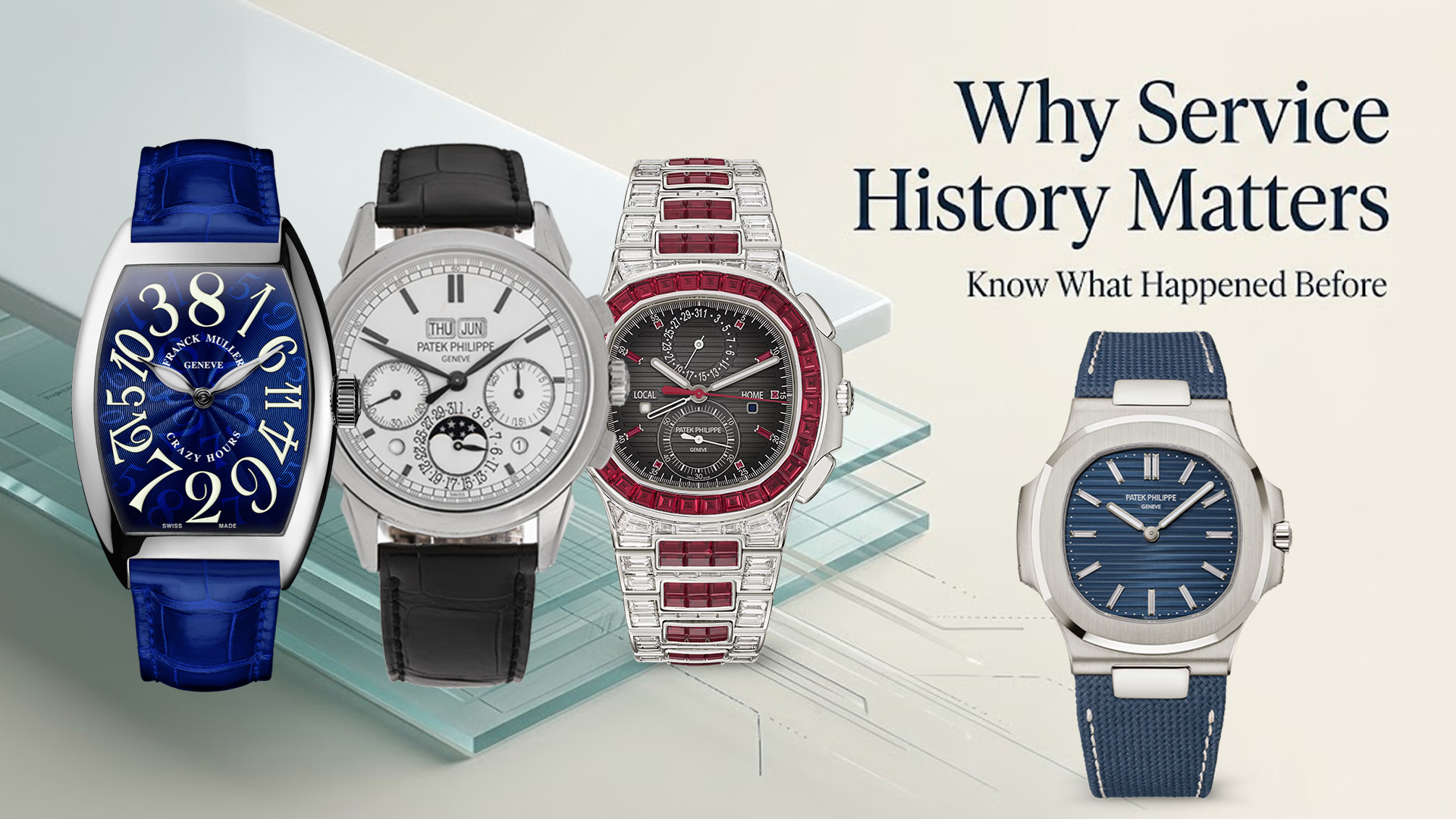
A pre-owned watch can look perfect and still be the watch that needs the most money spent on it next.
Fresh case. Clean bracelet. Beautiful dial. Full set.
Then you ask when it was last serviced.
Nobody knows.
This does not automatically make it a bad watch. Many excellent watches reach the secondary market without a complete paper trail.
But luxury watch service history helps buyers understand a part of the watch that listing photographs cannot show: its mechanical life.
A documented service history on a pre-owned luxury watch can help establish when maintenance occurred, who performed it and what components were repaired or replaced. A watch without service records can still be a strong purchase, but the unknown maintenance position should be considered alongside mechanical condition, reference complexity, asking price and potential future service cost.
What Is Luxury Watch Service History?
Service history can include:
- manufacturer service invoices;
- authorised-service paperwork;
- independent watchmaker invoices;
- repair receipts;
- pressure-test documentation;
- parts lists;
- warranty on completed service work.
The strongest records explain not simply that “a service happened,” but what work was actually performed.
A Service Receipt Can Tell You More Than the Date
Depending on the documentation, it may show:
- movement overhaul;
- gasket replacement;
- crown replacement;
- crystal replacement;
- dial or hand replacement;
- bracelet work;
- case refinishing;
- water-resistance testing.
Buyer insight: “Recently serviced” is useful only when you understand what “serviced” actually meant.
Manufacturer Service vs Independent Service
Neither phrase should automatically end the analysis.
Manufacturer service
Can provide clear brand documentation and work performed through the manufacturer’s service network.
Independent watchmaker service
Can also be excellent when performed by a highly qualified specialist with appropriate experience and parts access.
The important questions are:
- Who performed the work?
- What did they do?
- What parts were used?
- Is documentation available?
Why Collectors Sometimes Care About What Was Replaced
A mechanical service may improve reliability while changing originality.
For example, an older collector watch could receive:
- new hands;
- new crown;
- service dial;
- new bezel insert;
- new crystal.
Those components may be genuine manufacturer replacements.
They can still matter to collectors who value period originality.
Newly Serviced Does Not Automatically Mean More Original
This deserves emphasis.
A fresh manufacturer service may be excellent news mechanically.
It does not necessarily mean the watch remains in precisely the same configuration it had before service.
Read the paperwork.
Did the Service Include Polishing?
This connects mechanical history with cosmetic history.
Some services include or offer refinishing.
If polishing matters to you, ask whether the case or bracelet was refinished as part of the work.
A service invoice can sometimes provide useful clues.
Can You Buy a Used Watch Without Service History?
Yes.
Many buyers do.
But you should approach the purchase differently.
When service history is unknown:
- assess current mechanical performance;
- consider the watch’s age;
- consider complication;
- factor potential maintenance into ownership cost;
- avoid assuming “running” means “recently serviced.”
Running Well Today Does Not Reveal the Entire Mechanical History
A watch can keep reasonable time and still contain:
- aged lubricants;
- worn components;
- old seals;
- unknown past repairs.
Likewise, a watch with no records may have been serviced responsibly by an owner who simply lost the paperwork.
Service History Matters More on Complicated Watches
The more mechanically complex the watch, the more attention the maintenance position can deserve.
Examples include:
- chronographs;
- annual calendars;
- perpetual calendars;
- minute repeaters;
- tourbillons;
- split-seconds chronographs.
Richard Mille Service History
A highly technical Richard Mille deserves particularly careful mechanical due diligence.
Reference-specific functions may include:
- flyback chronograph;
- tourbillon;
- special rotor systems;
- complex case assemblies.
Service documentation can therefore be commercially meaningful.
Patek Philippe Service History
For complicated or vintage Patek Philippe references, buyers may care about both:
- mechanical maintenance;
- which original components remain.
The two questions should be analysed together.
Audemars Piguet Service History
On Royal Oak and Offshore models, also investigate whether previous service involved case or bracelet refinishing.
Mechanical condition is important, but so is preservation of AP’s distinctive external finishing.
Rolex Service History
On a modern Rolex, recent documented maintenance can improve buyer confidence.
On older collector references, buyers may also want to know whether service involved replacement:
- dial;
- hands;
- bezel;
- crown;
- bracelet components.
Do Not Apply a Universal Service Interval
Different brands, movements, complications, use patterns and environments create different maintenance needs.
The correct interval for one watch should not automatically be copied to another.
Follow current manufacturer guidance for the exact reference and consider how the watch is actually performing.
Water Resistance Is a Separate Maintenance Question
A watch advertised as 100, 200 or 300 meters water resistant when new does not automatically maintain that capability forever without testing and maintenance.
Gaskets and seals age.
Before deliberately exposing a used watch to water, understand its current condition rather than relying solely on original specifications.
Chronographs Need Functional Testing
Before buying, test where possible:
- start;
- stop;
- reset;
- counter alignment;
- pushers;
- date/other functions where applicable.
A recent service receipt is useful, but the watch should still function correctly today.
Mechanical Condition Is One Part of Total Condition
A strong pre-owned evaluation should consider:
| Condition Area | What to Review |
| Cosmetic | Scratches, dents, crystal, dial |
| Structural | Case geometry, bracelet, crown |
| Mechanical | Timekeeping and functions |
| Originality | Correct/service/aftermarket components |
| Service | Maintenance history and documentation |
| Documentation | Warranty card, receipts, service papers |
Does Full Set Mean Full Service History?
No.
A watch can have its original box and warranty card but no maintenance receipts.
Another watch may lack the original box yet include years of detailed service documentation.
They tell you different things.
Does Service History Prove Authenticity?
No.
Service paperwork can support provenance and mechanical history.
Authentication still requires examination of the watch itself and consistency of the overall evidence.
Use the Platinum Times U.S. authentication checklist for that separate process.
Should You Service a Watch Immediately After Buying?
Not automatically.
If the watch has:
- recent documented service;
- strong current performance;
- no mechanical concern;
immediate servicing may be unnecessary.
If history is unknown or performance raises concerns, inspection may be sensible.
Service Cost Should Be Part of the Purchase Price
Consider two watches.
Watch A is cheaper but has unknown service history.
Watch B costs more but has recent documented maintenance.
The lower asking price does not automatically mean Watch A will be cheaper to own.
Think in terms of:
purchase price + immediate likely ownership cost.
Why Platinum Times USA Emphasises the Individual Watch
Platinum Times Company USA operates across a wide range of pre-owned brands and references.
A Rolex Submariner, Patek perpetual calendar and Richard Mille chronograph cannot be evaluated through one generic maintenance rule.
Buyers can use the Platinum Times pre-owned watch buying checklist for broader due diligence and then evaluate service history at the reference level.
Service-History Questions to Ask the Seller
- When was the watch last serviced?
- Who performed the work?
- What was repaired or replaced?
- Was polishing/refinishing performed?
- Are invoices available?
- Was water resistance tested?
- Is there service warranty remaining?
- Are original removed components included?
Frequently Asked Questions
Should I buy a used luxury watch without service history?
It can still be a good purchase. Unknown service history simply creates additional uncertainty that should be considered alongside current mechanical condition and price.
Is manufacturer service always better?
Manufacturer service provides clear brand-network documentation, but qualified independent specialists can also perform excellent work. Evaluate who serviced the exact watch and what was done.
Does a recent service increase watch value?
It can improve buyer confidence and reduce near-term maintenance uncertainty, but the effect varies by reference and market.
Can servicing reduce originality?
A service may involve genuine manufacturer replacement parts or refinishing. This can matter to originality-focused collectors even when the work is mechanically appropriate.
How often should a luxury watch be serviced?
There is no single interval for every watch. Follow current manufacturer guidance for the reference and consider condition, performance and usage.
Does service paperwork prove a watch is authentic?
No. It is supporting documentation, not a substitute for physical authentication.
Should I service my watch before selling it?
Not automatically. Obtain an evaluation first because some buyers prefer to assess the watch in its current state.
Final Considerations
A beautiful pre-owned watch tells you what happened to the outside.
Service history helps tell you what happened inside.
Neither should be considered alone.
The strongest purchase is the watch whose cosmetic condition, mechanical condition, originality, documentation and price make sense together.
Evaluate Pre-Owned Watches With Platinum Times USA
Browse the Platinum Times luxury-watch inventory and use the company’s pre-owned buying checklist when evaluating the history of an individual watch.
If you have a watch with documented service records and are considering a sale or trade, include that information when submitting through the Platinum Times Sell/Trade service.
Leave a Reply