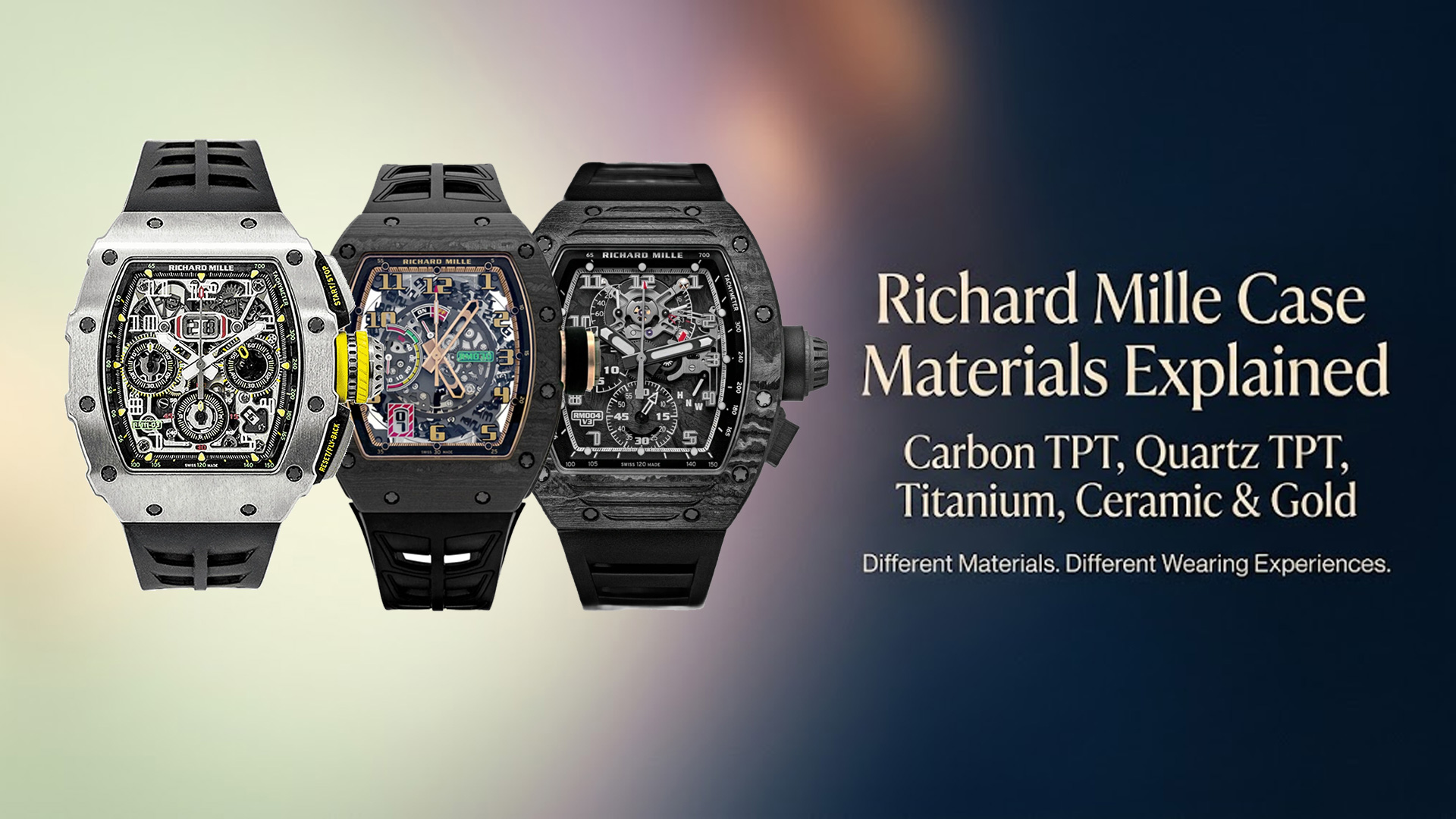
With Richard Mille, the case material isn’t decoration. It changes the weight, the look, the durability and often the price of the watch. Here is what each one means for you as a buyer.
Ask someone why a Richard Mille costs what it does, and the conversation usually lands on materials within a minute or two. That is no accident. More than almost any other watch brand, Richard Mille has built its identity around engineering materials, many developed or adapted specifically for its watches.
For a buyer, this creates a very practical question. When you see the same Richard Mille model offered in Carbon TPT, in titanium and in red gold, what are you actually choosing between? Is one tougher? Lighter? More comfortable? More likely to scratch? And does the material affect how easy the watch will be to sell later?
This guide answers those questions in plain English. If you’d like to see real examples while you read, review the current Richard Mille collection at Platinum Times.
Why Materials Matter So Much at Richard Mille
Richard Mille has long compared its watches to racing machines built for the wrist. Lightness, rigidity and shock resistance are design goals, not marketing afterthoughts. Many of its watches are designed to be worn during sport, by athletes in tennis, golf and motorsport.
That philosophy shows up in the case. A lighter case is more comfortable, so the watch can be worn during activity. A stronger, more rigid case protects complex movements. Exotic materials also create a visual identity that is instantly recognizable, which is one reason Richard Mille cases look so different from traditional steel or gold watches.
Carbon TPT: The Material Most People Picture
If a Richard Mille has a dark case with wavy, almost wood-grain or Damascus-like layers, it is probably Carbon TPT.
What it is
Carbon TPT, short for Thin Ply Technology, is made by North Thin Ply Technology (NTPT), a long-time Richard Mille partner. Carbon filaments are separated into very thin layers, each no thicker than about 30 microns, then impregnated with resin. The layers are stacked so that the fiber direction changes by 45 degrees from one layer to the next. The material is then cured under heat and pressure and machined into case parts.
Machining cuts through those layers at different angles. That is why every Carbon TPT case shows its own pattern. No two are exactly the same.
What it means for you
- Very light: often the most comfortable choice for all-day or active wear.
- Rigid and durable: well suited to sporty use.
- Unique appearance: each case pattern is individual, which many owners love.
- Different wear pattern: Carbon TPT doesn’t polish like metal. Deep marks are a different repair question from scratches on a gold case, which is worth remembering on pre-owned examples.
Quartz TPT: Color Meets Composite
Quartz TPT takes the same layered approach but uses silica (quartz) fiber layers, which can be colored. That’s how Richard Mille produces bright white, red, blue, pink and other vivid cases with a layered look.
Quartz TPT is often combined with Carbon TPT in a single case. Alternating layers create striking striped patterns, and some models mix the two across the bezel, case band and caseback.
For fashion-focused buyers, Quartz TPT is often the most expressive choice in the lineup. It brings color without paint or coating. The color is part of the material itself. On pre-owned examples, look closely at lighter colors for discoloration, marks or staining, especially on white and pastel cases.
Gold Carbon TPT and Gold Quartz TPT
Richard Mille has also produced versions in which gold leaf is layered within the TPT material. The result shows golden flecks or veins running through the composite. It’s a more decorative take on a technical material, and these variants usually appear on specific references or limited pieces. If you see one, confirm the exact reference and material designation in the documentation.
Grade 5 Titanium: Where Richard Mille Started
Grade 5 titanium is a titanium alloy known for its strength-to-weight ratio and corrosion resistance. Richard Mille has used it from its early years for cases and for many movement components and screws.
What it means for you
- Light and comfortable, although Carbon TPT is often lighter still.
- Familiar metal look with satin and polished finishes.
- Generally well tolerated by sensitive skin, which matters if steel or some alloys bother you.
- Shows scratches, although they can often be refinished by qualified service.
Titanium Richard Milles tend to feel a little more classic and understated than composite versions. If you want the RM shape and engineering without the striking layered look, titanium is worth a close look.
Ceramic: ATZ White and Black Ceramic
Richard Mille uses advanced ceramics on certain models, including ATZ (Alumina Toughened Zirconia), a bright white ceramic, and black TZP ceramics.
Ceramic is extremely scratch-resistant and keeps its color and finish for years. The trade-off is that ceramic is brittle compared with metal. A hard impact can chip or crack it rather than simply dent it. When inspecting a pre-owned ceramic RM, look closely at edges and corners.
Precious Metals: Red Gold, White Gold and More
Richard Mille also produces watches in 18K gold, including red gold, often designated 5N, and white gold, as well as combinations of gold with composites.
Gold changes the experience completely. The watch becomes heavier and more traditionally luxurious. Gold is softer than titanium or ceramic, so it shows wear more readily, but it can be refinished by qualified service. For buyers who want a Richard Mille that reads as fine jewelry as much as engineering, gold or gold-and-composite combinations are the natural choice.
Richard Mille Case Materials Compared
| Material | Weight on the wrist | Scratch behavior | Impact behavior | Look |
| Carbon TPT | Very light | Good resistance; doesn’t polish like metal | Strong and rigid | Dark, layered, unique pattern |
| Quartz TPT | Very light | Good resistance; check light colors for marks | Strong and rigid | Colored, layered |
| Grade 5 titanium | Light | Scratches; usually refinishable | Tough; can dent | Gray metal, technical |
| Ceramic (ATZ / TZP) | Light to moderate | Highly scratch-resistant | Can chip or crack | Bright white or black, clean |
| 18K gold | Heaviest | Softer; shows wear; refinishable | Can dent | Warm or white precious metal |
Treat this table as a general guide. Behavior varies with the specific model, finish and construction, and Richard Mille often combines materials in one case.
How Material Affects Resale and Pricing
Material is one of several factors that shape Richard Mille pricing. Reference, condition, completeness, limited-edition status and broader market demand all matter too. Some materials and color combinations attract more interest than others at any given time, but that can change. No material is a guaranteed store of value.
For sellers, condition matters most. A composite case with deep damage, a ceramic case with chips, or a gold case that has been heavily polished will all be judged carefully. Keep your documentation organized. Our guide to selling a Richard Mille in the USA explains what buyers usually look for.
Buying a Pre-Owned Richard Mille: Material-Specific Checks
- Confirm the exact reference and material. The same model may exist in several materials and in limited variants. The papers should match the case.
- Inspect edges and corners. Look for chips on ceramic, marks on light-colored Quartz TPT and dents or heavy polishing on metal cases.
- Check the strap. Rubber straps wear, and original straps and buckles can be costly to replace.
- Review service history. Richard Mille movements are complex, so documented service is valuable. See our guide to service history on used luxury watches.
- Verify authenticity. Richard Mille is widely counterfeited. Use our authentication checklist and buy from a seller who inspects and stands behind the watch.
- Understand condition grading. Our guide to luxury watch condition grades explains terms like “unworn” and “excellent.”
Which Material Is Right for You?
If you want the lightest, most comfortable watch, Carbon TPT is often the answer.
If you want color and personality, look at Quartz TPT or a mix of Carbon and Quartz TPT.
If you want a more traditional metal feel, titanium keeps the RM engineering with a cleaner look, and gold adds warmth and weight.
If you hate scratches, ceramic resists them extremely well. Just be mindful of hard knocks.
If you’re comparing specific models, our comparison of the Richard Mille RM 11-03 and RM 35-03 shows how differently two RM references can wear and function.
Frequently Asked Questions
What is Carbon TPT?
Carbon TPT is a composite made by stacking very thin layers of resin-impregnated carbon fiber, each up to about 30 microns thick, with the fiber direction shifted by 45 degrees between layers. It is light, rigid and produces a unique layered pattern on every case.
What is the difference between Carbon TPT and Quartz TPT?
Both use a thin-ply layering process. Quartz TPT uses silica fiber layers that can be colored, which allows white and brightly colored cases. The two are often combined in one case.
Which Richard Mille material is the most durable?
It depends on what you mean by durable. Ceramic resists scratches best but can chip on impact. Carbon TPT and titanium handle knocks well. Gold is softest but can be refinished. Choose based on how you’ll wear the watch.
Is a Carbon TPT Richard Mille lighter than titanium?
Carbon TPT cases are generally among the lightest options, although total weight depends on the model, movement and strap.
Do composite cases scratch?
Carbon and Quartz TPT resist scratching well but are not immune to marks. Unlike metal, they can’t simply be polished in the same way, so condition on pre-owned examples matters.
Does case material affect resale value?
It can, along with the reference, condition, completeness and market demand. Demand for specific materials and colors changes over time, so no material guarantees value.
Can I sell or trade my Richard Mille with Platinum Times?
Yes. You can submit a selling or trade enquiry with your watch’s details and a photo.
Final Thoughts
Choosing a Richard Mille material is really choosing how the watch will feel and behave in your life. Light and technical, colorful and expressive, classic and metallic, or rich and heavy: each material says something different, and each comes with its own care considerations.
Platinum Times is an independent pre-owned luxury-watch business based in Laredo, Texas, and is not affiliated with Richard Mille. Explore available Richard Mille watches, or ask the team about a specific reference.
Leave a Reply