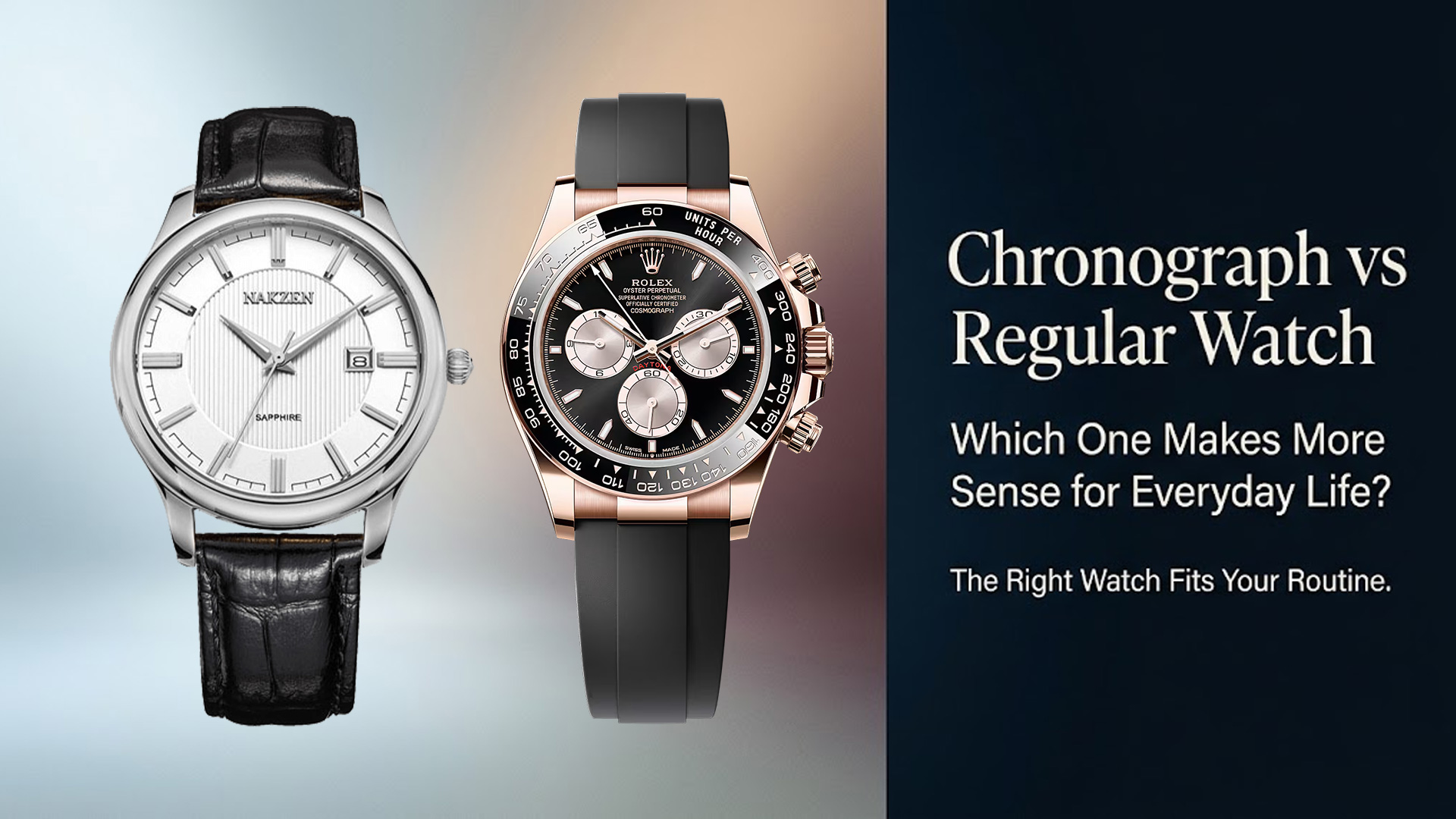
Those Extra Dials Look Impressive, but Do You Actually Need Them? The Answer Might Surprise You
A chronograph has a way of attracting attention. The extra counters, pushers, detailed markings, and instrument-like appearance make it feel as though there is much more happening beneath the dial.
Then you look at a simpler watch. Three hands, a clean arrangement of hour markers, perhaps a date window. Nothing appears excessive, and everything has a clear purpose.
Both can be beautifully made. Both can represent impressive watchmaking. But they offer quite different experiences on the wrist.
The chronograph vs regular watch decision is not really about choosing the more advanced watch. It’s about understanding which functions you’ll enjoy, how those functions affect design, and whether the added complexity suits your lifestyle.
For first-time luxury-watch buyers, this distinction is particularly useful because a watch that appears technically impressive may not necessarily be the most satisfying one to wear every day.
What Is a Chronograph Watch?
A chronograph watch includes a mechanism for measuring elapsed time, operating alongside the watch’s ordinary time display.
In a typical chronograph, a pusher starts and stops the timing function. Another pusher resets its indication, although controls and operating instructions vary by model.
Many chronographs feature a central chronograph seconds hand, together with smaller counters for elapsed minutes or hours.
The familiar arrangement of three subsidiary dials is only one possible design. Some chronographs have two counters, while others incorporate more specialized functions.
It’s important to distinguish a chronograph from a chronometer. A chronograph measures elapsed time; a chronometer is a designation associated with specified timekeeping performance and certification criteria.
A watch can be a chronograph, a chronometer, both, or neither.
What Is a Regular Three-Hand Watch?
A conventional three-hand watch typically displays hours, minutes, and running seconds. Some models also include a date display.
Its appeal is straightforward: the wearer can check the time quickly without the visual complexity of additional elapsed-time counters.
That simplicity doesn’t imply inferior engineering.
A well-finished time-only mechanical movement can be highly sophisticated. Likewise, a watch with relatively few complications may feature exceptional case finishing, materials, and craftsmanship.
Luxury-watch quality should not be measured by the number of functions displayed on the dial.
Chronograph vs Three-Hand Watch: The Main Differences
| Feature | Chronograph Watch | Three-Hand Watch |
| Primary function | Time display plus elapsed-time measurement | Conventional time display |
| Dial appearance | Often features additional counters | Usually more straightforward |
| Case controls | Typically includes chronograph pushers | Usually operated mainly through the crown |
| Mechanical architecture | Includes timing mechanisms | Generally fewer complications |
| Case proportions | Can be thicker, depending on model | Can be slimmer, depending on model |
| Servicing | May involve more complex work | Depends on the individual movement |
| Ideal buyer | Someone who appreciates timing functions or technical design | Someone who values straightforward time reading |
These are general tendencies rather than universal specifications. Individual watches may differ considerably.
When Is a Chronograph Actually Useful?
A chronograph measures elapsed time, which can be helpful in ordinary situations.
You might use it to time a presentation, measure an interval during a hobby, keep track of a break, or observe the duration of an activity.
Those examples aren’t exclusive to expensive chronographs. A smartphone or inexpensive timer can perform many of the same tasks.
The appeal of a mechanical chronograph is partly the experience of using a carefully engineered function directly on the wrist.
For some owners, that interaction is one of the most enjoyable aspects of the watch.
For others, the timing function becomes something they demonstrate once and rarely use again.
Both experiences are normal. The important point is recognizing which describes you before deciding to pay for the added complexity.
The 60-Second Chronograph Test
Here’s a useful exercise when examining a chronograph.
With the manufacturer’s instructions available, learn how to start, stop, read, and reset the timing mechanism correctly.
Then consider:
- Can you quickly identify the running seconds display and chronograph seconds hand?
- Is the elapsed-time counter easy to read?
- Do the pushers feel comfortable to operate?
- Can you interpret the dial without confusion?
- Do you genuinely enjoy using the function?
If the interaction feels satisfying, a chronograph may offer something a simpler watch cannot.
If you find the dial unnecessarily complicated, there’s nothing wrong with preferring a watch focused on conventional time display.
For a pre-owned watch, proper operation should be confirmed rather than assuming that every chronograph mechanism is working correctly.
Why the Rolex Daytona Became a Recognizable Chronograph
The Rolex Cosmograph Daytona illustrates how a chronograph can combine practical mechanical functions with a distinctive visual identity.
The collection is closely associated with motorsport and features an elapsed-time mechanism alongside a tachymetric scale.
Rolex explains that this scale can be used with the chronograph to calculate average speed over a known distance under appropriate measurement conditions.
That connection between function and design is part of the Daytona’s appeal.
But a modern Daytona is not necessarily the ideal watch for everyone. Its detailed dial, case construction, pricing, and wearing character may differ from what a buyer wants from a daily watch.
Collectors interested in this style can explore Rolex references available through Platinum Times Co. USA and compare individual configurations.
Confirm the exact reference and its current availability before treating any listing as a purchasing option.
Do Chronograph Watches Have Better Movements?
Not automatically.
A chronograph movement performs additional functions, but added complexity doesn’t establish superior timekeeping, reliability, or overall craftsmanship.
Movement quality depends on engineering, construction, adjustment, maintenance, and the standards applied to the particular watch.
Chronograph architecture also varies. Different movements may use distinct systems to control the timing mechanism.
Some employ column-wheel mechanisms, while others use different operating arrangements. Clutch systems and movement layouts can also differ.
These technical choices interest many enthusiasts, but they should be researched at the level of the exact calibre rather than generalized across every chronograph.
Does a Chronograph Cost More to Maintain?
The presence of additional mechanisms can make servicing more involved, but it’s not responsible to assign a universal maintenance premium.
Service cost depends on the manufacturer, calibre, condition, age, required work, and service provider.
An older chronograph with replacement-part challenges may require particular expertise. Another model may have established manufacturer support.
A simple time-only watch can also be expensive to service if it has unusual construction or significant damage.
Before buying either style, ask about the watch’s condition and service history.
If it’s a pre-owned chronograph, ensure the timing functions have been appropriately checked as part of the overall assessment.
Which Is Better for Office Wear?
Both watch styles can work beautifully in professional settings.
A relatively simple three-hand watch may sit discreetly beneath a shirt cuff. Its clean dial can complement formal clothing without drawing much attention.
A chronograph can create a more expressive appearance, particularly when it has contrasting subdials, a prominent bezel, or additional case pushers.
Neither style belongs exclusively to a particular profession.
The better choice depends on your clothing, working environment, personal preference, and the comfort of the actual watch.
Consider case thickness as well as diameter. A watch with a relatively moderate diameter can still sit high on the wrist if its case construction is substantial.
Which Watch Makes a Better First Luxury Purchase?
For someone buying a first luxury watch, simplicity can be attractive because it makes the watch easy to understand and use.
However, a chronograph may be the right starting point if the buyer is genuinely interested in motorsport-inspired design or mechanical timing functions.
There’s no requirement to begin collecting with a particular complication.
The most useful approach is to compare two watches at a similar intended budget and evaluate the complete ownership proposition.
Look at size, dial legibility, condition, movement, servicing needs, and what you would actually enjoy wearing.
To explore different design directions, browse the luxury-watch collection at Platinum Times Co. USA and research specific models without assuming every listed watch has the same movement or condition.
Five Questions Before Choosing a Chronograph
- Would I use or enjoy its elapsed-time function?
- Do I prefer a busy, instrument-like dial or a simpler display?
- Does the case thickness suit my usual clothing?
- Do I understand the movement and its maintenance requirements?
- Would I still love this watch if I rarely operated the chronograph?
The final question is especially helpful.
A chronograph can be worth owning for its design and engineering even when the timing function is used infrequently. The decision becomes more satisfying when you recognize that preference instead of inventing a practical need for the complication.
Frequently Asked Questions
What is the difference between a chronograph and a regular watch?
A chronograph includes an elapsed-time measurement function, while a conventional three-hand watch primarily displays hours, minutes, and seconds.
Is a chronograph the same as a chronometer?
No. A chronograph is a timing complication. Chronometer terminology concerns defined timekeeping-performance standards and certification.
Can I use a chronograph every day?
Yes, provided the watch is in appropriate condition and used according to its manufacturer’s instructions. It can function as an everyday wristwatch as well as an elapsed-time instrument.
Are chronograph watches always thicker?
No. Many chronographs have substantial cases, but dimensions vary by movement architecture and design. Compare actual specifications rather than assuming one size.
Is the Rolex Daytona a chronograph?
Yes. The Rolex Cosmograph Daytona incorporates a mechanical chronograph and a tachymetric scale associated with its motorsport heritage.
Should I buy a chronograph for investment purposes?
No watch complication guarantees appreciation or profitable resale. Evaluate the exact reference, condition, purchase price, and ownership goals independently of speculative expectations.
Final Verdict: Choose the Watch You’ll Enjoy Using
The chronograph vs regular watch decision comes down to what you value in a timepiece.
A chronograph provides an additional mechanical function and often a visually detailed design. A simpler three-hand watch offers a more straightforward display that many people find satisfying for daily use.
Neither style is automatically more luxurious, practical, or collectible.
The right watch is the one that fits your wrist, your lifestyle, and your appreciation of its design and movement.
Interested in a specific model? Compare relevant references and contact Platinum Times Co. USA with the watch details to ask about the specifications and condition of a current listing.
Leave a Reply