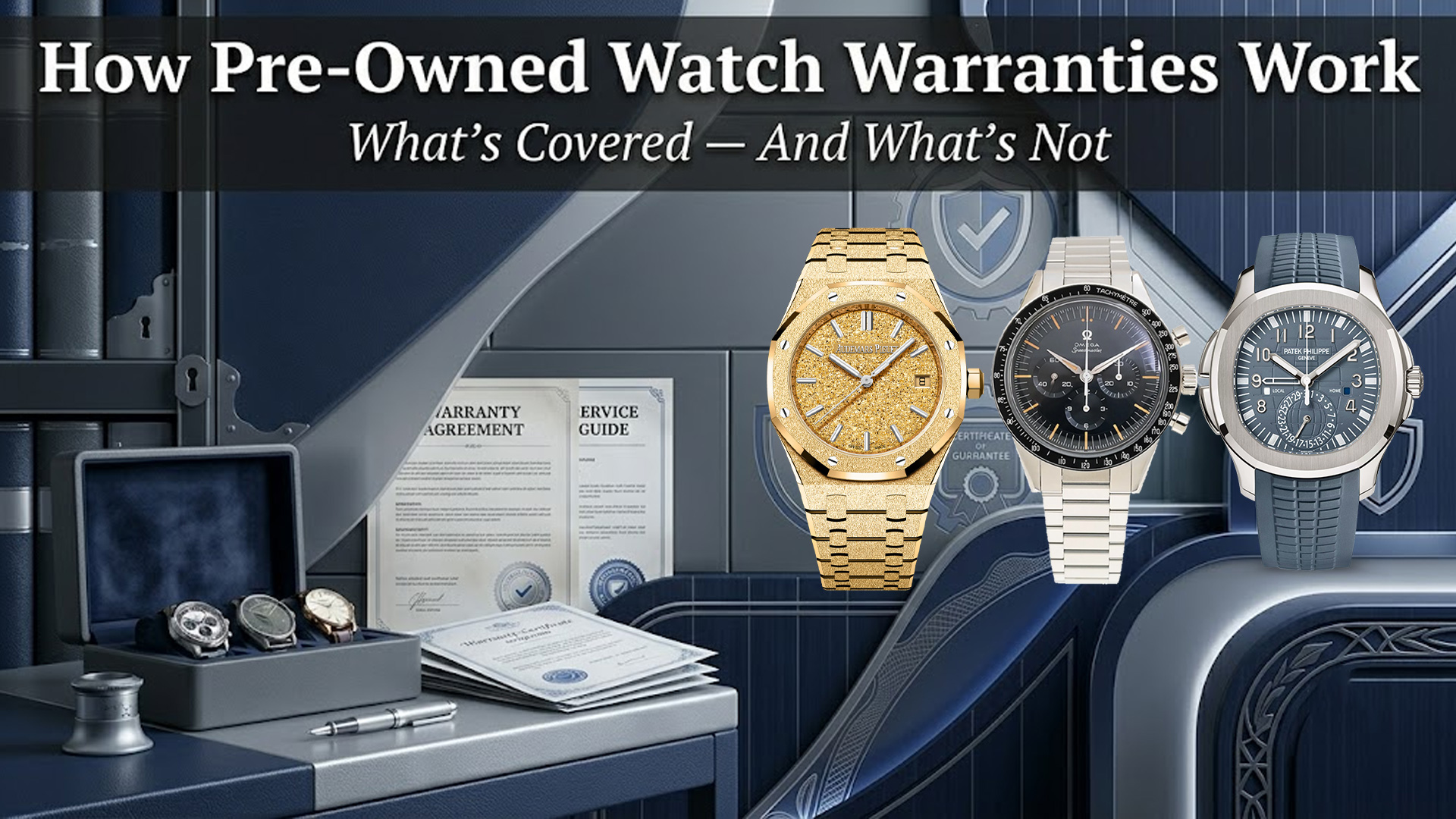
⌚ A Warranty Sounds Reassuring—But What Does It Actually Protect?
A warranty can make buying a pre-owned watch feel more secure, but the word itself does not explain how much protection you are receiving. One watch may include remaining manufacturer coverage, another may come with a dealer-backed warranty, and a third may be protected through a separate service provider.
Before purchasing a high-value timepiece, buyers should understand who provides the coverage, when it begins, what problems it includes, which situations are excluded, and how a claim would be handled. A clearly written pre-owned luxury watch warranty should remove uncertainty rather than create more of it.
A pre-owned luxury watch warranty provides repair coverage for specific mechanical or functional problems during a defined period after purchase. Coverage varies by manufacturer, dealer, and watch, so buyers should confirm the provider, duration, exclusions, repair process, and covered components in writing before making payment.
Key Takeaways
- A manufacturer warranty and a dealer warranty are different forms of coverage.
- An original warranty card does not always mean factory coverage is still active.
- Most watch warranties cover specified mechanical problems, not cosmetic wear or accidental damage.
- Water resistance should be confirmed through recent testing rather than assumed from the case rating.
- A warranty and a return policy serve different purposes.
- Coverage for complications, shipping, replacement parts, and servicing should be confirmed before purchase.
What Is a Pre-Owned Luxury Watch Warranty?
A watch warranty is a written agreement stating that a manufacturer, dealer, or service provider will address certain covered problems during a specified period. Depending on the terms, the provider may inspect, repair, service, or replace eligible components if the watch develops a qualifying fault.
The key word is covered. A warranty is not unlimited insurance against every possible problem. It normally applies only to the issues listed in the agreement and may become invalid if the watch is damaged, modified, improperly used, or opened by an unauthorized repairer.
Buyers exploring pre-owned luxury watches in the USA should review warranty coverage alongside the watch’s authenticity, condition, service history, documentation, and final purchase price.
Expert insight: A warranty should be treated as a written service commitment, not simply a reassuring phrase in a product description.
What Types of Warranty Can a Pre-Owned Watch Include?
Pre-owned watches may be sold with several different forms of protection. Understanding who stands behind the coverage is the first step in evaluating its real value.
Manufacturer Warranty
A manufacturer warranty is issued by the watch brand when the timepiece is originally sold through an authorized retail channel. If the original warranty period has not expired, the remaining coverage may continue for a later owner, depending on the brand’s terms.
Buyers should confirm:
- The original warranty activation date
- Whether the warranty remains transferable
- Whether registration was required
- Whether the watch was originally sold through an authorized source
- Whether previous servicing or modifications affect coverage
- Which documents are required for a claim
The presence of a warranty card can support the ownership history of a watch, but it does not automatically prove that active manufacturer coverage remains.
Dealer Warranty
A luxury watch dealer warranty is provided by the business selling the watch. If a covered issue develops, the buyer normally contacts the dealer rather than the manufacturer.
Dealer-backed coverage can provide valuable reassurance, particularly when the seller offers a clear inspection process and a direct point of contact after the transaction. However, the scope of coverage can vary substantially between dealers.
Before buying, ask:
- Who will inspect the watch if a claim is submitted?
- Where will repairs be completed?
- Are all movement functions covered?
- Who pays for insured shipping?
- What replacement components may be used?
- What happens if the watch cannot be repaired?
Service Warranty
A recently serviced watch may include a limited warranty from the manufacturer, authorized service center, or independent watchmaker that completed the work.
This type of warranty usually applies to the specific repair or service performed. It may not cover unrelated components, accidental damage, or problems that develop elsewhere in the movement.
Third-Party Warranty
Some sellers use an independent warranty administrator or service company. In this arrangement, another organization may be responsible for approving and processing claims.
Buyers should confirm the name of the provider, the repair location, any deductibles, shipping responsibilities, claim deadlines, and whether authorization is required before the watch is opened or serviced.
Does an Original Warranty Card Mean the Watch Is Still Covered?
No. A pre-owned watch may include its original warranty card even after the factory coverage has expired. The card remains an important part of the watch’s documentation, but active protection depends on the original sale date and the manufacturer’s conditions.
Factory warranty status may depend on:
- The date the warranty was activated
- The original coverage period
- Whether the card was completed correctly
- Whether online registration was required
- Whether coverage transfers to another owner
- Whether the watch has been modified
- Whether unauthorized servicing has taken place
A warranty card may still strengthen provenance and future resale confidence after its coverage has ended. However, buyers should never interpret the card as proof of an active warranty without checking the dates and conditions.
Buyer insight: The warranty card supports the history of the watch. The written warranty terms determine whether protection is still active.
What Does a Pre-Owned Watch Warranty Usually Cover?
Coverage differs between providers, but many warranties focus on faults affecting the internal mechanical operation of the watch.
Depending on the agreement, covered problems may include:
- Failure of the movement to run
- Timekeeping outside the stated operating standard
- Problems with winding or setting
- Power-reserve failure
- Date or calendar malfunction
- Chronograph operating problems
- GMT or dual-time function failure
- Mechanical defects identified during the coverage period
Buyers considering watches with additional complications should ask whether every function is covered. A basic movement warranty may not automatically include an annual calendar, perpetual calendar, chronograph, alarm, tourbillon, minute repeater, or another complex mechanism.
Mechanical Coverage Does Not Always Include Routine Maintenance
A warranty normally addresses unexpected covered faults. Routine servicing, lubrication, pressure testing, regulation caused by normal use, battery replacement, polishing, and strap replacement may be treated as regular ownership expenses rather than warranty claims.
What Is Commonly Excluded From a Luxury Watch Warranty?
Most warranties contain exclusions designed to separate manufacturing or mechanical faults from damage caused by wear, misuse, accidents, or outside intervention.
Common exclusions may include:
- Normal scratches, marks, and cosmetic wear
- Dents or damage caused by impact
- Broken or chipped crystals
- Worn leather, rubber, textile, or fabric straps
- Bracelet stretch and clasp wear
- Loss, theft, or disappearance
- Water damage not specifically covered
- Damage caused by improper crown or pusher use
- Unauthorized repairs or modifications
- Aftermarket components
- Magnetization, shock, or environmental damage
- Problems disclosed before the purchase
- Normal servicing and maintenance
A buyer should not assume that a dealer warranty functions like insurance. Insurance may protect against risks such as theft, accidental loss, or physical damage, while a standard watch warranty generally applies to defined mechanical faults.
Is Water Damage Covered?
Water resistance is one of the most important details to clarify before buying a used watch. A depth rating engraved on the case or printed on the dial reflects the watch’s original design. It does not guarantee that the seals remain effective years later.
Gaskets age, crowns wear, cases are opened during service, and previous impacts can affect the integrity of the watch. A recent pressure test provides far more useful information than the original depth rating alone.
Ask These Questions Before Exposing the Watch to Water
- Has the watch been pressure-tested recently?
- What level of water resistance was confirmed?
- Were the seals or gaskets replaced?
- Is water damage included in the warranty?
- Does the crown need to be screwed down before use?
- Are chronograph pushers safe to operate underwater?
Watchmaker perspective: Water resistance is a condition that must be maintained and tested. It should never be assumed permanently.
How Warranty Coverage Relates to Watch Condition
The cosmetic condition of a watch and its warranty status are separate considerations. An unworn watch may have no remaining factory coverage, while a watch with visible signs of use may still be protected by a manufacturer, dealer, or recent service warranty.
A warranty may also exclude issues that were already visible or disclosed before the sale. For example, existing scratches, bracelet wear, fading, or a damaged strap would not normally become repairable warranty claims simply because the watch was sold with coverage.
Before purchasing, compare the warranty with the actual condition report. Review the case, bezel, dial, crystal, bracelet, clasp, movement functions, and service information individually.
Warranty Coverage Does Not Replace Authentication
Authentication and warranty coverage answer different questions.
- Authentication: Is the watch genuine and accurately represented?
- Warranty: What support is available if a covered issue develops after purchase?
A dealer warranty should not be treated as proof that every component is original. An authentic watch may include a service dial, replacement hands, aftermarket strap, new crown, or another disclosed component.
Buyers should complete an authentication review before relying on post-purchase coverage. The Platinum Times Co. luxury watch authentication checklist explains how to assess the reference, case, dial, movement, serial information, documentation, and seller disclosures.
What Is the Difference Between a Warranty and a Return Policy?
A warranty and a return policy protect the buyer in different ways.
- A return policy explains whether a buyer can send the watch back after purchasing it.
- A warranty explains whether eligible faults will be repaired or otherwise addressed after the sale.
A watch can include mechanical warranty coverage while remaining ineligible for return. Another seller may allow a short return period but provide limited or no long-term mechanical protection.
Both policies should be reviewed before payment. Platinum Times Co. buyers should read the current return and refund policy separately from the warranty information supplied for the individual watch.
How to Compare Pre-Owned Watch Warranties
The longest warranty is not automatically the strongest. The real value depends on the provider, scope, exclusions, repair process, and quality of support.
Compare the Following Details
- Provider: Manufacturer, dealer, watchmaker, or third-party company
- Duration: Exact start and expiration dates
- Coverage: Included movement functions and complications
- Exclusions: Problems and situations that are not protected
- Repair process: Where and how the watch will be serviced
- Replacement parts: What type of components may be installed
- Shipping: Who arranges and pays for insured transportation
- Documentation: What the buyer must provide during a claim
- Transferability: Whether coverage remains after resale
- Resolution: What happens if the watch cannot be repaired
Expert insight: A clearly written warranty from a responsive specialist can be more useful than longer coverage filled with unclear exclusions.
Questions to Ask Before Buying a Warrantied Watch
- Who provides the warranty?
- When does the coverage begin?
- When does it expire?
- Does any manufacturer warranty remain active?
- Which movement functions are covered?
- Are all complications included?
- Is water damage covered or excluded?
- What actions could invalidate the warranty?
- Where will covered repairs be completed?
- Who pays for insured shipping during a claim?
- What replacement components may be used?
- Which documents must be retained?
Important answers should be confirmed through the product listing, invoice, warranty document, email, or another permanent written record.
Buying a Pre-Owned Watch With Warranty Coverage in the USA
Online shopping allows buyers throughout the United States to access a wider selection of luxury watches than they may find locally. However, purchasing across state lines makes written coverage and a clear claim process especially important.
Whether the buyer is located in Texas, Florida, California, New York, or another U.S. market, the following details should be confirmed before payment:
- The seller’s business identity
- The exact watch reference
- The watch’s condition and service history
- The warranty provider and complete terms
- The insured shipping method
- Signature requirements at delivery
- Sales tax and total purchase cost
- The process for submitting an out-of-state claim
Buyers should also review the Platinum Times Co. shipping policy and frequently asked questions before completing a transaction.
Does Warranty Coverage Increase the Value of a Pre-Owned Watch?
Active coverage can make a watch more attractive because it reduces some of the uncertainty associated with early ownership. This can be especially valuable for complicated movements, recently released references, or watches that may be expensive to service.
However, a warranty is only one part of the overall value. Buyers should also consider:
- Authenticity
- Originality
- Physical condition
- Mechanical condition
- Service history
- Box and papers
- Market demand
- Seller credibility
A watch without long-term coverage may still represent an excellent purchase when it has documented recent service, transparent condition information, and an appropriate price. The complete ownership package matters more than one feature.
Pre-Owned Luxury Watch Warranty Checklist
- Identify the exact warranty provider.
- Confirm the start date and duration.
- Check whether manufacturer coverage remains.
- Read every covered item and exclusion.
- Confirm whether complications are protected.
- Ask how water resistance is treated.
- Understand where repairs will be performed.
- Confirm who pays for insured claim shipping.
- Ask what replacement parts may be used.
- Keep the listing, invoice, warranty document, and correspondence.
- Review the return policy separately.
- Obtain all important clarification before payment.
Final Thoughts
A pre-owned luxury watch warranty can provide meaningful protection, but only when its terms are clear. Buyers should know who provides the coverage, how long it lasts, which problems are included, what can invalidate it, and how a claim will be handled.
The strongest purchase is supported by more than a warranty. It combines an authentic watch, an honest condition report, transparent service history, credible documentation, a trustworthy seller, and clearly written transaction terms.
When those elements align, warranty coverage becomes an additional layer of confidence rather than the only reason to trust the purchase.
Explore Pre-Owned Luxury Watches at Platinum Times Co.
Browse available timepieces from leading luxury brands and confirm the condition, documentation, included accessories, warranty information, and purchase terms for the exact watch you are considering.
Explore the Pre-Owned Luxury Watch Collection
For questions about a specific watch or its coverage, contact Platinum Times Co.
Frequently Asked Questions About Pre-Owned Watch Warranties
Do pre-owned luxury watches come with a warranty?
Answer: Some pre-owned watches include remaining manufacturer coverage, a dealer warranty, a service warranty, or third-party protection. Coverage is not automatic, so buyers should confirm the exact terms for the individual watch before purchasing.
Is a dealer warranty the same as a manufacturer warranty?
Answer: No. A manufacturer warranty is issued by the watch brand under its own conditions. A dealer warranty is provided by the seller, which normally manages eligible inspections and repairs directly or through a selected service provider.
Does an original warranty card mean factory coverage is still active?
Answer: Not necessarily. Factory coverage may have expired or may depend on activation, registration, transfer, and servicing requirements. The card can still support provenance even when the original warranty is no longer active.
What does a used luxury watch warranty normally cover?
Answer: Coverage may include specified mechanical faults involving the movement, timekeeping, winding, power reserve, date, chronograph, GMT, or other included functions. The exact coverage depends on the written warranty.
Does a pre-owned watch warranty cover accidental damage?
Answer: Accidental damage is commonly excluded. Scratches, impacts, broken crystals, misuse, theft, loss, and unauthorized repairs normally require separate insurance or are the responsibility of the owner.
Is water damage covered by a luxury watch warranty?
Answer: Water damage may be excluded, especially when the watch was not recently pressure-tested or was used outside the stated conditions. Buyers should confirm water-resistance testing and coverage before exposing a pre-owned watch to water.
Can outside servicing invalidate a watch warranty?
Answer: It can. Unauthorized opening, modification, or repair may invalidate the warranty. Buyers should contact the warranty provider before allowing another watchmaker or service center to work on the watch.
What documents should I keep for a warranty claim?
Answer: Keep the invoice, warranty document, original product listing, payment confirmation, reference and serial information, service records, shipping documents, and all written communication relating to the purchase.
Leave a Reply