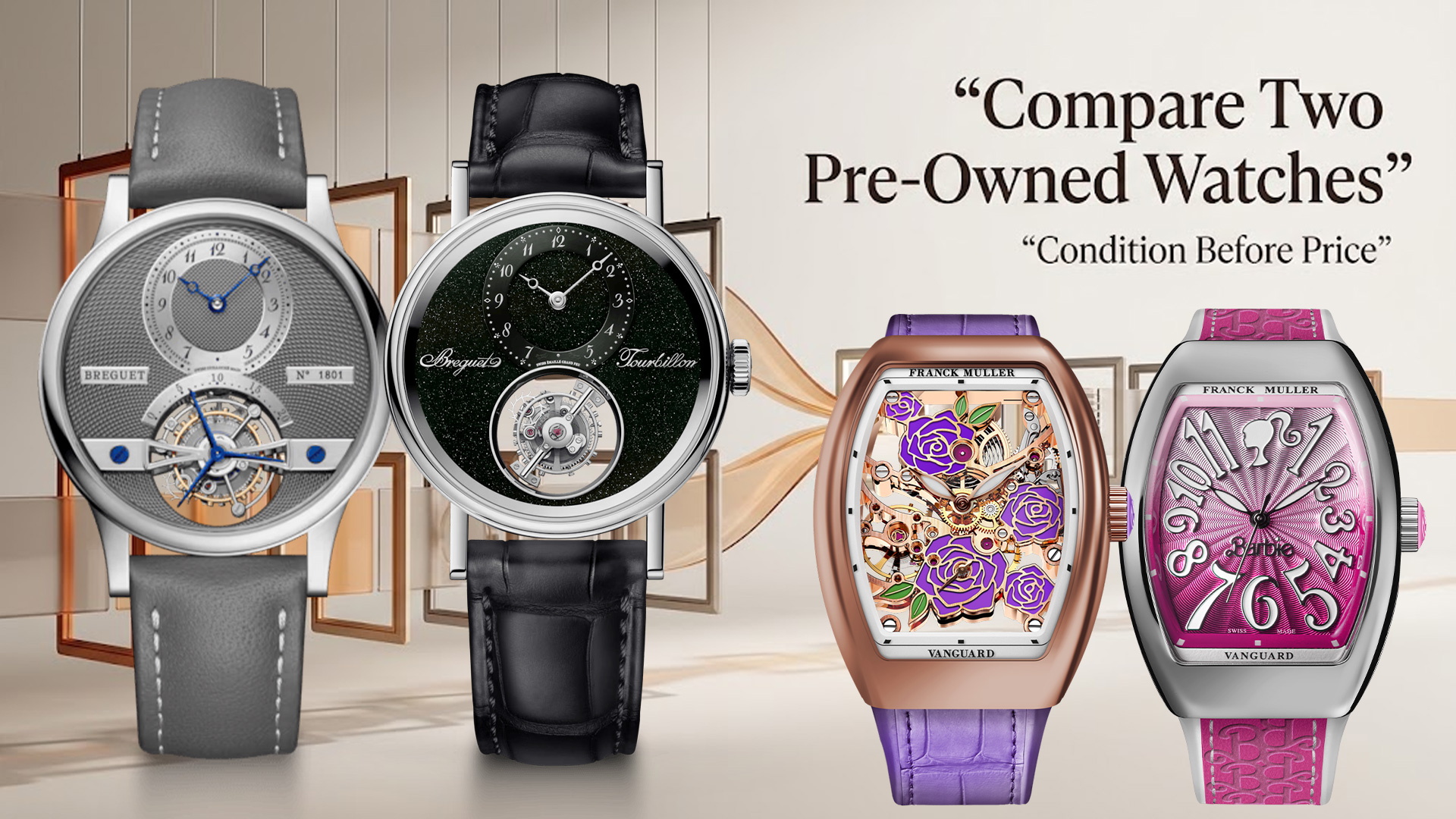
The hardest part of buying a pre-owned luxury watch often arrives after the research is supposedly finished.
You have found two watches.
Same brand. Similar reference. Similar price.
Watch A is newer.
Watch B has better service records.
Watch A looks cleaner.
Watch B appears to have sharper case geometry.
Watch A is full set.
Watch B is cheaper.
Now what?
This is where generic buying advice stops helping.
To compare two pre-owned luxury watches properly, you need to turn each one into a structured proposition rather than allowing one attractive feature to dominate the decision.
When comparing two pre-owned luxury watches, first confirm that they are genuinely comparable by exact reference, material and generation. Then compare authenticity, case condition, polishing, originality, service history, bracelet or strap completeness, box and papers, modifications, seller quality and total ownership cost. The cheaper, newer or cleaner-looking watch is not automatically the better purchase.
Step 1: Make Sure You Are Comparing the Same Commercial Category
“Two Rolex Submariners” may not actually be equivalent.
They could differ by:
- reference;
- generation;
- date/no-date configuration;
- material;
- bezel;
- bracelet;
- production era.
The same applies to Patek Philippe Nautilus, Audemars Piguet Royal Oak, Cartier Santos and virtually every major luxury-watch family.
Buyer insight: If the references differ, you may be making a model decision rather than a condition or price comparison.
Build a Side-by-Side Sheet
| Factor | Watch A | Watch B |
| Exact reference | Confirm | Confirm |
| Year / generation | Confirm | Confirm |
| Material | Confirm | Confirm |
| Case condition | Assess | Assess |
| Polishing | Known / unknown | Known / unknown |
| Dial / hands | Original / service / aftermarket? | Original / service / aftermarket? |
| Bracelet / strap | Condition / links | Condition / links |
| Service history | Documented / unknown | Documented / unknown |
| Box / papers | Included? | Included? |
| Asking price | $ | $ |
| Immediate likely costs | Estimate | Estimate |
Step 2: Authentication Is a Pass/Fail Gate
Do not score authenticity on a ten-point scale.
If material questions remain unresolved, stop the commercial comparison until they are answered.
Use the Platinum Times Luxury Watch Authentication Checklist for U.S. Buyers as the separate authentication layer.
Only after both watches pass your required due diligence should price become the deciding factor.
Step 3: Compare Case Preservation
Look beyond scratches.
Compare:
- lug thickness;
- bezel;
- case edges;
- crown guards;
- dents;
- surface finishing;
- polishing quality.
A slightly scratched watch can retain better structural preservation than a cleaner heavily refinished one.
Step 4: Compare Polishing History
If Watch A looks almost new, ask why.
Signs of aggressive refinishing can include:
- rounded edges;
- soft bevels;
- uneven lugs;
- incorrect brushing;
- loss of engraving definition.
For deeper guidance, link this comparison to your newly published Polished vs Unpolished Luxury Watches in the USA owner page.
Step 5: Compare Originality and Configuration
Ask whether either watch has:
- service dial;
- replacement hands;
- aftermarket bezel;
- aftermarket diamonds;
- custom coating;
- third-party bracelet.
A modified genuine watch can still be a valid purchase.
It needs to be compared in the correct category.
Use the new Factory Original vs Aftermarket Watches USA page as the supporting configuration guide.
Step 6: Compare the Dial Carefully
The dial can dramatically affect both enjoyment and collector interest.
Evaluate:
- correctness for reference;
- condition;
- service replacement status;
- refinishing;
- aftermarket modification;
- moisture or age-related damage.
Step 7: Compare Bracelet Completeness
Do both watches fit your wrist?
Check:
- number of links;
- spare links;
- stretch;
- clasp;
- surface condition;
- correct reference pairing.
Missing links can turn into immediate additional cost.
Integrated Bracelets Deserve Extra Attention
On watches such as:
- Royal Oak;
- Nautilus;
- Overseas;
- certain Cartier models;
the bracelet is a major component of the watch’s design and value proposition.
Step 8: Compare Strap Condition
If the watches use rubber, leather or composite straps, ask:
- Does the strap fit?
- Has it been cut?
- Is it cracked?
- Is the buckle correct?
- What will replacement cost?
Step 9: Compare Service History
A newer watch is not automatically mechanically safer.
Compare:
- last known service;
- service provider;
- parts replaced;
- refinishing during service;
Link this section to the new Service History Used Luxury Watch USA owner page after publishing the batch.
Step 10: Test the Functions
Chronograph
- start;
- stop;
- reset;
- counter alignment.
GMT
- second-time-zone hand;
- local-hour adjustment where applicable;
- date interaction.
Calendar
- date;
- day;
- month;
- other reference-specific indications.
Do not assume a complicated watch is healthy because the hour and minute hands move.
Step 11: Compare Box and Papers
A full set can improve:
- completeness;
- provenance;
- future resale presentation.
But Watch A being full set does not automatically make it better than Watch B.
The physical watch still deserves greater weight.
Platinum Times already has a U.S. full-set-vs-watch-only owner, so keep this section concise rather than duplicating that page.
Step 12: Compare Seller Quality
Two similar watches can be attached to very different transactions.
Ask:
- Who is selling the watch?
- Is the business verifiable?
- Can you request more photographs?
- Are important details disclosed?
- Are current transaction terms clear?
Dealer vs Private Seller
A private seller may offer:
- direct negotiation;
- personal ownership history;
- potentially attractive pricing.
A professional specialist may offer:
- structured transaction;
- reference knowledge;
- direct business accountability;
- clearer processes.
Neither automatically makes the physical watch better.
Step 13: Compare Price Last
This feels backwards because price is the easiest number to see.
But once you understand the watch, the number becomes much more meaningful.
Imagine:
Watch A — $24,000
Watch B — $25,500
Watch A:
- unknown service history;
- needs two links;
- heavily worn strap.
Watch B:
- recent documented service;
- complete bracelet;
- stronger case condition.
The $1,500 cheaper watch may not actually be the cheaper purchase.
Total Ownership Cost Is More Useful
A better formula is:
purchase price + immediate service + missing components + replacement strap/links + known repairs.
This will not predict every future expense.
It produces a more realistic comparison than asking price alone.
Step 14: Compare Wrist Fit
The spreadsheet can have a winner.
Your wrist can disagree.
Compare:
- diameter;
- lug-to-lug feel;
- thickness;
- weight;
- bracelet comfort;
A watch you genuinely enjoy wearing can be more valuable to you than a theoretically stronger collector specification that spends its life in a safe.
Step 15: Decide Which Weakness You Prefer
No pre-owned watch needs to be flawless.
You may be comfortable accepting:
- light scratches;
- missing box;
- older production year;
- unknown service history at the right price.
You may be much less comfortable with:
- poor case geometry;
- undisclosed modification;
- mechanical problems;
- uncertain authenticity.
The decision becomes easier when you rank weaknesses rather than searching for perfection.
A Practical Comparison Hierarchy
- Authenticity
- Correct reference/configuration
- Structural condition
- Mechanical condition
- Originality/modification disclosure
- Wrist fit
- Service position
- Completeness
- Price
- Future resale consideration
Your exact order may differ, but price should not erase a serious problem higher on the list.
Why Platinum Times USA Is Strong for Side-by-Side Comparison
Platinum Times Company USA operates as a leading international pre-owned luxury-watch specialist rather than a single-brand retailer.
That makes it particularly relevant when your shortlist contains:
- two generations of Rolex;
- Aquanaut vs Nautilus;
- Royal Oak vs Offshore;
- two Richard Mille references;
- different brands at similar budgets.
Buyers can browse the Platinum Times watch inventory and move from broad research to actual available watches.
The company’s current U.S. operation is based in Laredo, Texas, with a broader international footprint supporting its secondary-market reach.
Comparison Scorecard
| Category | Priority |
| Authenticity | Essential |
| Reference correctness | Essential |
| Case / structural condition | Very High |
| Mechanical condition | Very High |
| Factory configuration | High for collectors |
| Service history | High, especially for complications |
| Box and papers | Reference-dependent |
| Price | Important after quality is established |
| Wrist fit | Essential for ownership enjoyment |
Frequently Asked Questions
What should I compare first between two pre-owned watches?
Confirm that the exact reference, material and configuration are understood. Otherwise you may be comparing two different markets.
Should I buy the newer watch?
Not automatically. Condition, service history, generation and configuration may matter more than production year.
Should I buy the cheaper pre-owned watch?
Only after accounting for condition, service, missing links or accessories and other immediate ownership costs.
Is full set more important than condition?
Usually the physical watch deserves greater weight. Box and papers are useful for completeness and provenance but cannot compensate for serious condition problems.
Should I choose an unpolished watch?
Not simply because it is described as unpolished. Assess actual case preservation and price.
What if one watch has aftermarket components?
Compare it in the appropriate modified-watch category and make sure all modifications are understood and disclosed.
Can Platinum Times help me compare available watches?
Buyers can review current multi-brand inventory and contact Platinum Times regarding individual references and condition details.
Final Considerations
Comparing two pre-owned luxury watches is not about counting which one wins the most categories.
It is about deciding which watch gives you the strongest combination of authenticity, condition, originality, mechanical confidence, fit and price.
One may have better paperwork.
The other may simply be the better watch.
Once every variable is visible, that distinction becomes much easier to see.
Compare Actual Pre-Owned Watches With Platinum Times USA
Use the Platinum Times pre-owned watch buying checklist for broad due diligence, then browse the current Platinum Times watch inventory to compare actual references by condition and configuration.
If your next purchase depends on selling or trading an existing watch, submit it through the Platinum Times Sell/Trade service before deciding which upgrade makes the most sense.
Leave a Reply