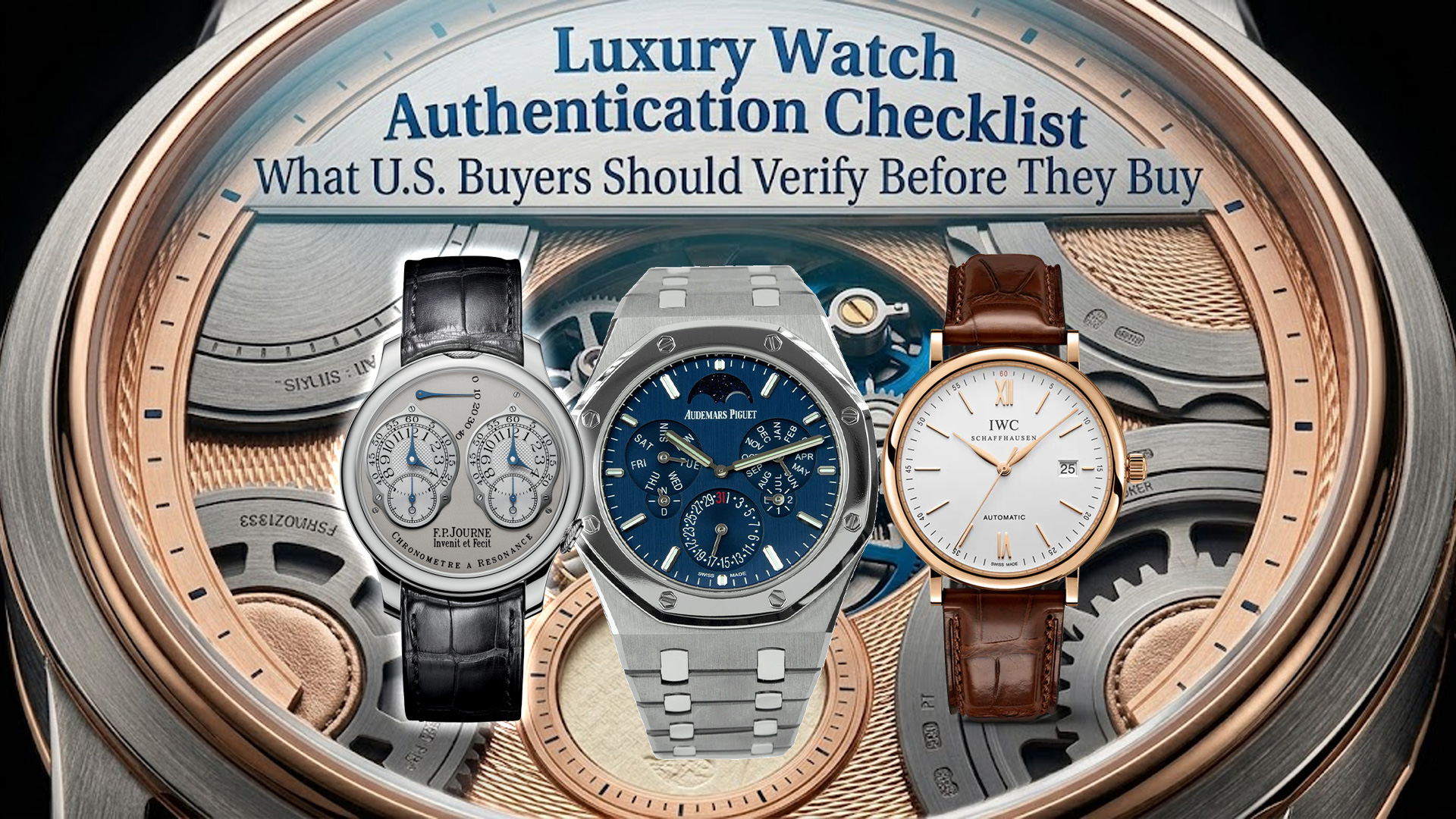
🛡️⌚ Buying a Luxury Watch Soon? One Missed Detail Can Turn a Dream Purchase Into an Expensive Lesson
Luxury watch authentication checklist for U.S. buyers is not just a helpful idea. It is one of the most important safeguards in the entire pre-owned luxury watches market. Many buyers focus first on price, brand, or visual appeal, but the smarter approach is to focus on authenticity, seller credibility, documentation, and consistency before anything else. In luxury watch buying, excitement can make people move too fast. A good checklist slows the process down in exactly the right way.
The reality is simple. A watch can look impressive and still raise serious questions. A strong brand name does not protect a buyer from poor due diligence. A polished listing does not automatically guarantee a polished truth. That is why serious buyers treat watch authentication like a layered process. They do not rely on one sign. They look for multiple signals that support each other: the correct reference number, a believable ownership story, clean box and papers, consistent condition, original components, and a seller who sounds organized rather than evasive.
In the U.S. market, where buyers often compare listings quickly and move across brands like Rolex, Patek Philippe, Audemars Piguet, and Hublot, a disciplined authentication process protects both money and confidence. The goal is not to become paranoid. The goal is to become methodical. When you buy a high-value watch, certainty matters.
The Platinum Times watch environment itself reflects that trust-driven structure. The live pre-owned luxury watches page presents the inventory under a visible 100% Certified Authentic statement and organizes browsing by brand, model, condition, movement, case size, and other filters, which reinforces how authentication and structured product information sit at the center of premium watch buying.
Why Watch Authentication Is More Than Spotting a Fake
Many buyers think authentication means asking only one question: is the watch fake or real? In practice, the process is far more detailed than that. A serious luxury watch authentication checklist helps buyers evaluate whether the watch feels complete, correctly represented, and commercially safe to own.
A watch can be authentic and still raise concerns if it includes replaced parts, heavy refinishing, incorrect components, missing documentation, or an unclear ownership story. That does not always make the watch a bad purchase, but it absolutely changes how the buyer should think about price, trust, and future resale. Good authentication is not only about protecting against outright fraud. It is also about protecting against incomplete understanding.
That is why smart buyers look beyond the dial logo. They study whether the entire package makes sense. The listing, the watch, the paperwork, the pricing, and the seller all need to align. When one part of the story feels off, the rest deserves closer attention.
The First Rule: Start With the Seller, Not the Watch
One of the biggest mistakes buyers make is focusing only on the product photos. The better first move is to evaluate the seller. A serious seller usually communicates clearly, provides specific information, answers direct questions without hesitation, and presents the watch in a structured way. A weaker seller often relies on vagueness, pressure, missing details, or language that sounds defensive instead of informative.
That is why the source matters. A buyer comparing watches through a structured environment such as the broader luxury watch collection often gets a stronger starting point because the watches are already organized by brand, condition, model, and other relevant filters. The same structured feel appears on major category pages like the Rolex collection, Patek Philippe collection, and Audemars Piguet collection, which helps buyers evaluate watches inside a more professional context.
A strong seller does not remove the need for a checklist, but it gives the buyer a better foundation. Authentication is easier when the seller already respects the process.
The Core Luxury Watch Authentication Checklist
- Confirm the exact brand, model, and reference number
Authentication starts with precision. If the watch cannot be identified correctly, nothing else should move forward. A serious buyer should know the exact model family and reference. “Rolex Datejust” is not enough by itself. “Patek Philippe Nautilus” is not enough by itself. The watch should be identifiable in a way that lets you compare it against known examples.
When you review live internal examples like the Rolex Datejust, the Patek Philippe Nautilus, and the Audemars Piguet Royal Oak, you can see how model-specific presentation gives buyers clearer context around the watch they are evaluating.
- Check whether the watch details are internally consistent
A proper listing should make sense from top to bottom. The model name, reference number, case style, bracelet or strap type, dial style, and overall visual presentation should all align. If the listing feels pieced together or if the language seems uncertain, that is a sign to slow down.
Consistency is one of the most basic but most powerful forms of authentication. A watch that is described precisely and coherently is easier to trust than one that sounds like it is being guessed at as the sale progresses.
- Review the box and papers carefully
Box and papers do not guarantee authenticity on their own, but they often strengthen the confidence profile of the watch. Original warranty card, box, manuals, hang tags, proof of purchase, and service documents help support the watch’s identity and ownership story. Missing paperwork does not automatically make the watch unsafe, but it does reduce the confidence cushion.
Buyers should also be careful not to assume every piece of packaging carries equal weight. Originality matters. A random replacement box is not the same as original packaging tied to the watch’s history. Good authentication means understanding exactly what is included and what that inclusion actually proves.
- Study the condition like a buyer, not like an admirer
Authentication is not only about whether the watch is real. It is also about whether the watch is honestly represented. Study the case edges, bracelet or strap, clasp, dial, crystal, crown, and overall finish. Does the condition description match what the eye sees? Are there signs of heavy polishing? Do the details look coherent for the model being presented?
A smart buyer does not use beauty as proof. A beautiful watch still needs structural credibility. Honest condition reporting is part of the authentication process because it reveals whether the seller is describing the watch carefully or simply trying to create excitement.
- Ask about service history
Service records can strengthen buyer confidence because they add real documentation to the ownership story. If the watch has been serviced, ask where, when, and what work was done. If there is no service history, that is not automatically a deal-breaker, but it should be understood as part of the total risk picture.
The goal here is not to demand a perfect history every time. The goal is to understand whether the watch has a believable paper trail that supports the way it is being sold today.
- Check for originality, not just authenticity
Many buyers stop at the question of whether the watch is authentic, but originality matters too. Replaced parts, aftermarket modifications, altered dials, or heavily refinished surfaces can all affect the commercial value and future resale confidence of the watch. A buyer should know whether the piece is being sold as an untouched example, a serviced watch with documented changes, or a watch with modifications that change how it should be valued.
This is especially important on brands and model families where collector sensitivity is higher. A watch can still be authentic and yet deserve a different price conversation if its originality profile has changed.
- Compare the watch inside the right market context
Authentication becomes easier when the buyer compares the watch to other properly presented examples. Looking at organized brand environments such as the Rolex collection, Patek Philippe collection, or Audemars Piguet collection helps buyers understand how premium listings are normally structured and what kind of detail serious presentation includes.
That comparison process helps reveal when a watch feels unusually vague, oddly described, or poorly supported. In many cases, authentication is easier when the buyer has better context.
- Be realistic about the price signal
Price is not proof by itself, but it is still a signal. If the number seems too aggressive in either direction, ask why. A watch that looks excellent, claims strong documentation, and sits in a premium model family but is priced oddly low deserves extra caution. A watch priced unrealistically high may simply reflect seller optimism, but it can also suggest the seller does not fully understand the watch. In both cases, price should lead to more questions, not fewer.
Smart buyers do not let a “great deal” override their checklist. The better rule is simple: the more attractive the opportunity looks, the more disciplined the verification should become.
What Serious Buyers Usually Ask Before They Commit
A strong buyer conversation often includes very practical questions:
- Is the watch fully authentic?
- Are the major visible components consistent with the model and reference?
- Does it include original box and papers?
- Has it been serviced, and is that documented?
- Are there any aftermarket or replaced parts?
- Is the condition description completely honest?
- Does the price make sense for the full package being offered?
These are not difficult questions, but they are powerful ones. Sellers who can answer them clearly tend to create stronger trust. Sellers who cannot often reveal more than they intend.
Common Red Flags in Luxury Watch Authentication
- Vague model details
If the seller cannot clearly identify the watch, slow down immediately. - Incomplete or evasive answers
Serious sellers usually answer direct questions with direct information. - Weak or inconsistent paperwork
Missing paperwork is not always fatal, but unclear paperwork is more concerning than simply incomplete paperwork. - Condition that does not match the description
If the words and the images do not align, trust should drop. - Pricing that feels disconnected from the story
Numbers that seem too convenient often deserve more verification, not less. - Overreliance on brand name
A watch is not proven authentic just because the seller keeps repeating the brand with confidence. - Pressure to move quickly
Rushed decisions are where authentication mistakes happen most often.
Why Buyers Should Think About Future Resale During Authentication
One of the smartest ways to authenticate a watch emotionally and commercially is to think one step ahead. Ask yourself a simple question: if you bought this watch today, how would you explain it to the next buyer later? Would the paperwork help? Would the service history strengthen the story? Would the listing details give you enough confidence to defend the watch again in the future?
This mindset matters because authentication is not only about present certainty. It is also about future confidence. A watch that feels easy to justify later is usually a safer watch to buy now.
Mistakes U.S. Buyers Make When Authenticating a Watch
- Focusing only on appearance
Fix: Treat visual appeal as one factor, not proof. - Trusting the brand name too quickly
Fix: Verify the exact model, reference, and supporting details. - Ignoring missing paperwork
Fix: Missing box and papers do not always stop a purchase, but they should change the depth of your review. - Confusing authenticity with originality
Fix: A watch can be authentic and still include changes that affect value and future resale. - Letting price override caution
Fix: Attractive pricing should trigger more careful verification, not impulsive optimism. - Skipping seller evaluation
Fix: Start with the seller’s clarity and professionalism before trusting the watch story. - Buying without a structured checklist
Fix: Use a repeatable process so excitement never becomes the main decision-maker.
FAQs
What is the most important part of a luxury watch authentication checklist for U.S. buyers?
The most important part is consistency. The seller, the watch, the reference, the paperwork, the condition, and the price all need to make sense together. Authentication becomes stronger when multiple signals support each other.
Do box and papers prove a watch is authentic?
No, not by themselves. They help support confidence, provenance, and resale strength, but they should be treated as one part of a larger verification process.
Can a watch be authentic but still be a weaker buy?
Yes. A watch can be authentic and still include aftermarket parts, unclear service history, heavy polishing, or missing documentation that changes the commercial quality of the purchase.
Why does the reference number matter so much?
The reference number helps anchor the watch to a real model identity. Without that, meaningful comparison and proper verification become much harder.
Should buyers trust a good price if everything else looks fine?
A good price can be real, but it should never replace the checklist. The better the deal looks, the more carefully the buyer should verify every part of the story.
How important is service history in authentication?
It can be very important because it adds documentation and helps support the watch’s history. It is not mandatory in every case, but it can strengthen trust significantly.
What is the difference between authenticity and originality?
Authenticity asks whether the watch is genuinely from the brand. Originality asks whether the parts, condition profile, and overall state remain consistent with how the watch should exist in the market.
What is the safest way to compare watches before buying?
Use structured category environments and compare listings that provide model details, condition, and documentation clearly. That context helps buyers spot weak presentation more easily.
Final Thoughts
Luxury watch authentication checklist for U.S. buyers is really about building confidence through layers. The smartest buyers do not ask only whether the watch looks right. They ask whether the whole story feels right. They verify the seller, the reference number, the box and papers, the condition, the service background, the originality, and the pricing logic before they let emotion take over.
For readers who want stronger internal buying context, the most useful starting points are the broader pre-owned luxury watches collection, the category pages for Rolex, Patek Philippe, and Audemars Piguet, plus live product examples like the Rolex Datejust, Patek Philippe Nautilus, and Audemars Piguet Royal Oak, where model-level presentation helps show what a more structured buyer experience looks like.
Leave a Reply