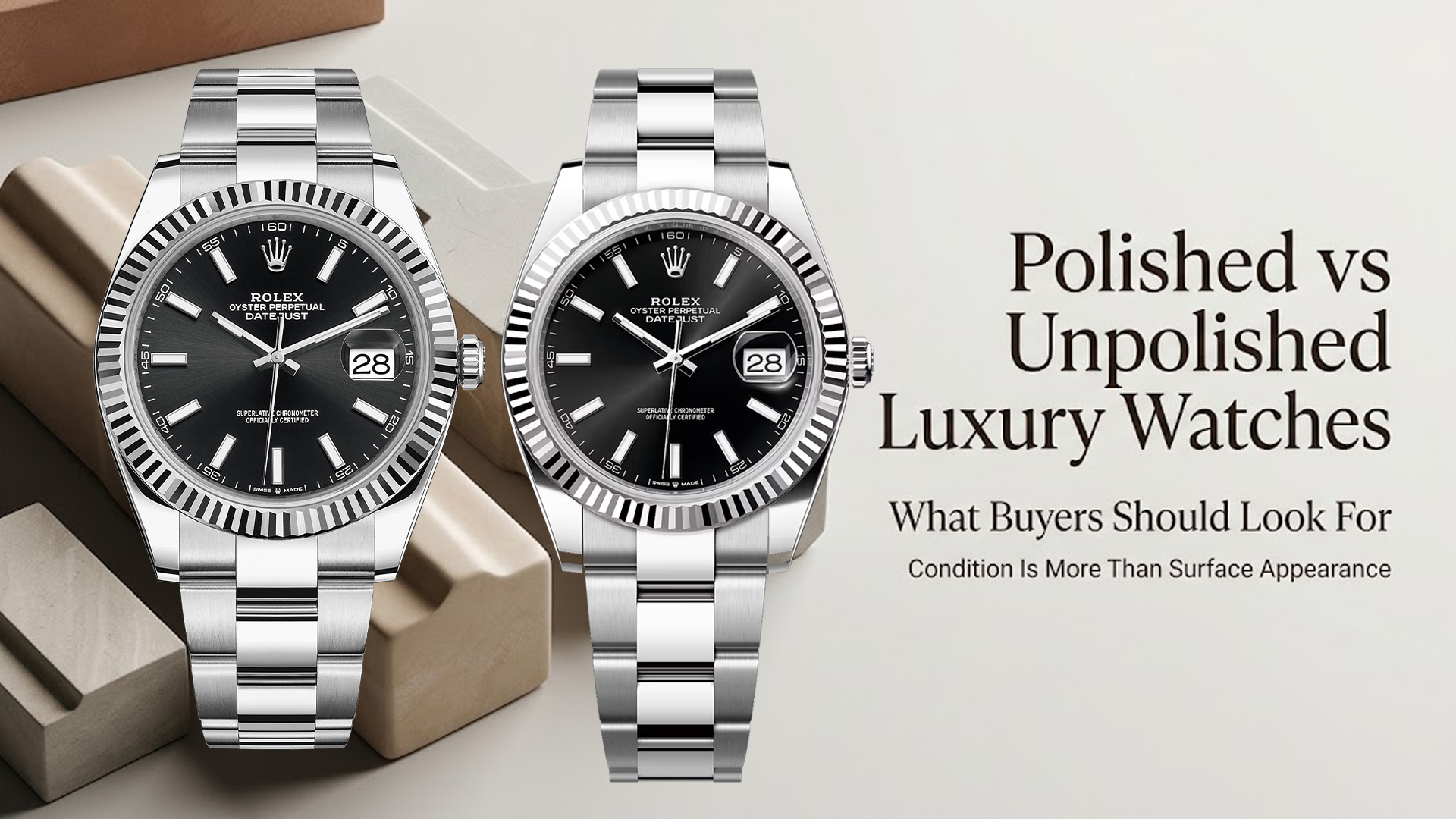
Two pre-owned watches sit beside each other.
One is covered in light scratches. The bezel has a few marks. The clasp clearly shows that somebody actually wore it.
The second looks almost new.
Most first-time buyers choose the cleaner watch immediately.
Experienced collectors usually ask another question first:
Why does it look cleaner?
That question takes you into one of the most misunderstood areas of the pre-owned market: polished vs unpolished luxury watches.
Professional refinishing can dramatically improve appearance. Poor or repeated polishing can also soften case edges, alter brushed surfaces and remove some of the original geometry collectors value.
At the same time, the word “unpolished” should never automatically make a scratched watch more desirable or justify an unrealistic premium.
The real goal is not to buy the watch with the most fashionable condition label. It is to understand what has happened to the case and whether the result suits your priorities.
An unpolished luxury watch is not automatically better, and a polished watch is not automatically undesirable. What matters is how much material has been removed, whether the original case geometry and finishing remain correct, the quality of any refinishing, and the expectations of buyers for that specific reference. Collector-sensitive Rolex, Patek Philippe and Audemars Piguet watches often deserve particularly careful inspection.
What Does “Polished Watch” Actually Mean?
Polishing or refinishing generally means treating the external metal surfaces of the watch to reduce scratches and restore a cleaner appearance.
That may involve recreating:
- high-polished surfaces;
- brushed surfaces;
- satin finishes;
- case bevels;
- bracelet finishing.
A professional refinishing job is not simply somebody rubbing the entire watch until it becomes shiny.
Different areas of a luxury-watch case can have different finishes, sometimes meeting at extremely precise boundaries.
What Does “Unpolished” Mean?
In a listing, “unpolished” normally means the seller believes the case has not undergone cosmetic refinishing.
That can be attractive because it suggests the original factory geometry has been preserved.
But buyers should treat unpolished as a condition claim that still needs examination.
On an older watch with several previous owners, establishing its complete cosmetic history may be difficult.
Buyer insight: “Unpolished” should describe the watch, not replace the inspection.
Why Collectors Care About Original Case Geometry
A luxury-watch case is not just a container for the movement.
Its geometry is part of the design.
Collectors may examine:
- lug thickness;
- bevels;
- case edges;
- bezel profile;
- brushed-to-polished transitions;
- case symmetry.
If repeated polishing removes too much material, those details can become softer.
A Scratched Watch Can Be Better Preserved Than a Perfect-Looking Watch
This sounds contradictory until you separate cosmetic cleanliness from structural preservation.
Watch A may have visible hairlines but strong original edges.
Watch B may look immaculate because it has been aggressively refinished several times.
For an everyday buyer, Watch B might still look more attractive.
For a collector focused on originality, Watch A may be the stronger example.
Does Polishing Lower Watch Value?
Sometimes.
Not always.
And there is no responsible universal percentage.
The market effect depends on:
- brand;
- reference;
- age;
- rarity;
- extent of polishing;
- quality of work;
- collector sensitivity.
Light Professional Refinishing vs Heavy Polishing
These should not be treated as equivalent.
Light, skilled refinishing
May improve appearance while retaining much of the original geometry.
Aggressive or repeated polishing
Can potentially create:
- rounded lugs;
- soft bevels;
- uneven case sides;
- blurred brushed/polished boundaries;
- reduced engraving definition.
Rolex Polished vs Unpolished
Rolex is one of the brands where this question appears constantly.
Collectors may inspect:
- lug shape;
- case thickness;
- crown guards;
- bracelet finish;
- clasp;
- caseback edges.
A polished Rolex can still be a very good watch.
The concern is whether the work has altered the proportions materially.
Audemars Piguet Royal Oak Requires Even More Attention
Royal Oak finishing is especially sensitive because the design depends on highly visible transitions between brushed and polished surfaces.
Look closely at:
- bezel edges;
- case bevels;
- integrated bracelet links;
- surface direction;
- overall sharpness.
On this type of watch, refinishing quality can influence the entire visual architecture.
Patek Philippe Cases Deserve the Same Discipline
Condition-focused Patek Philippe buyers often care deeply about:
- case proportions;
- lug shape;
- bezel definition;
- bracelet finishing;
This becomes increasingly important on older, discontinued or collector-sensitive references.
Should You Avoid Every Polished Vintage Watch?
No.
Many older watches have been serviced and cosmetically refinished during their lives.
Rejecting every vintage watch that may have been polished can eliminate many otherwise excellent examples.
Instead ask:
- How much original geometry remains?
- How attractive is the watch today?
- How rare is an untouched example?
- Does the asking price reflect the condition?
When Polishing May Make Sense
A buyer purchasing primarily to wear the watch may prefer a professionally refinished example.
That can be reasonable if:
- the work is appropriate;
- the reference is not unusually originality-sensitive;
- the price makes sense;
- the buyer understands what has been done.
When Leaving the Watch Alone May Be Smarter
If the watch already has:
- strong case geometry;
- light normal wear;
- collector significance;
- rare original finishing;
there may be little reason to refinish it simply to remove minor scratches.
Never Polish a Watch Just to Sell It Without Thinking
Sellers sometimes assume that a shiny watch automatically receives a better offer.
That can backfire.
A knowledgeable buyer may prefer the original wear pattern and make their own decision about refinishing later.
Ask Whether Polishing Happened During Service
Service history and cosmetic history can overlap.
If records are available, ask:
- Was refinishing requested?
- Was the case polished?
- Was the bracelet refinished?
- Were components replaced?
Can You Always Tell if a Watch Has Been Polished?
No.
Excellent work can be difficult to identify without deep familiarity with the reference.
Poor work may be obvious.
That is another reason to avoid simplistic online tests.
Photos to Request Before Buying Remotely
Ask for sharp, well-lit images showing:
- both case profiles;
- all lugs;
- bezel;
- bracelet sides;
- clasp;
- caseback;
- deep scratches or dents.
A single straight-on dial photograph tells you very little about case preservation.
Condition, Authenticity and Originality Are Separate Questions
This distinction is essential.
A polished watch can be authentic.
An unpolished watch can still contain an incorrect component.
A cosmetically excellent watch can still require mechanical work.
For authentication-specific due diligence, use the Platinum Times Luxury Watch Authentication Checklist for U.S. Buyers.
How Platinum Times USA Fits Into the Condition Decision
Platinum Times Company USA operates within the international pre-owned luxury-watch market, where individual condition differences matter enormously.
The company’s current U.S. site lets buyers browse watches by reference and condition while also providing direct communication for additional details.
For buyers comparing a polished and unpolished example, that reference-level approach is more useful than relying on a generic condition label.
Browse the current Platinum Times pre-owned luxury-watch inventory and request additional condition information where needed.
Polished vs Unpolished Buyer Checklist
| Question | Why It Matters |
| Is polishing known? | Establishes cosmetic history where possible |
| Are case edges strong? | Shows geometry preservation |
| Are lugs symmetrical? | Can reveal heavy refinishing or damage |
| Are brushed/polished finishes correct? | Indicates quality of work |
| Is the bracelet also refinished? | Condition is not limited to the case |
| Is the asking price appropriate? | Condition should be reflected commercially |
Frequently Asked Questions
Is an unpolished luxury watch always worth more?
No. Unpolished status can appeal strongly to collectors, but condition, reference, rarity and asking price still matter.
Is buying a polished Rolex bad?
No. A properly refinished Rolex can still be an excellent purchase. The concern is excessive material removal or altered case geometry.
Can polishing affect resale value?
Yes, particularly on collector-sensitive watches if the work materially alters the original case or bracelet finishing. There is no universal percentage.
Are scratches better than polishing?
Not automatically. Some buyers prefer normal original wear; others prefer a cleaner professionally refinished watch.
Can a dealer prove a watch is unpolished?
Sometimes cosmetic history is documented, but on older watches certainty can be difficult. Inspect the physical case rather than relying on the label alone.
Should I polish my watch before selling it?
Not automatically. Obtain an evaluation first, especially for collectible or high-value references.
Can Platinum Times evaluate my watch before I refinish it?
Owners can submit watches through the Platinum Times Sell/Trade service so the current condition can be considered before making unnecessary cosmetic changes.
Final Considerations
A pre-owned luxury watch does not need to look new to be a strong example.
Sometimes the light scratches you notice first are evidence that the original case underneath them has been left largely alone.
Sometimes a carefully refinished watch is exactly what a buyer wants.
The important thing is to understand the difference between cosmetic cleanliness and preservation before paying for either.
Compare Pre-Owned Watch Condition With Platinum Times USA
Explore the Platinum Times pre-owned luxury-watch inventory and compare individual watches by reference, condition and configuration rather than appearance alone.
If you own a luxury watch and are considering polishing it before a sale or upgrade, submit the watch first through the Platinum Times Sell/Trade service. Preserving the current condition may be the better decision depending on the reference.
Leave a Reply